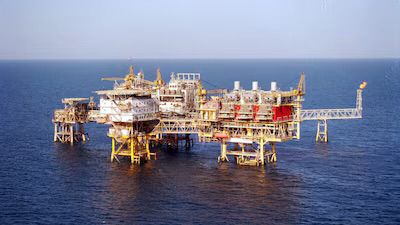
New Delhi: India is preparing for one of its largest offshore energy exploration exercises in recent years as the government moves ahead with an extensive oil and gas survey across multiple regions in the Bay of Bengal. The ambitious project is aimed at identifying untapped hydrocarbon reserves beneath the seabed and strengthening the country’s long term energy security.
The exploration initiative is being planned by the Directorate General of Hydrocarbons and will cover major offshore basins including Bengal Purnea, Mahanadi, Krishna Godavari, Cauvery and the Andaman region. Bids for the project were floated on May 14 as part of the government’s broader push to expand domestic energy production.
The surveys will involve advanced two dimensional broadband marine seismic and gravity magnetic data acquisition technology. In practical terms, specialised survey vessels will scan deep below the ocean floor using sound wave imaging systems to identify underground rock structures where commercially viable oil and natural gas reserves may exist.
The scale of the operation is enormous. The Bengal Purnea and Mahanadi regions alone will see surveys covering nearly 45,000 line kilometres, while another 43,000 line kilometres each are planned for the Andaman and Krishna Godavari basins. The Cauvery Basin survey will extend across approximately 30,000 line kilometres, with the entire exercise expected to continue over nearly two years.
India currently imports nearly 85 percent of its crude oil requirements, making the country highly vulnerable to global oil price shocks and geopolitical instability. Recent international conflicts and fluctuations in energy markets have intensified concerns regarding long term energy dependence.
Officials believe India’s eastern offshore regions remain significantly underexplored compared to western offshore fields such as Mumbai High. Geological assessments suggest several deepwater regions may contain substantial undiscovered hydrocarbon reserves.
The Andaman Basin has attracted particular attention due to its geological similarity to gas producing regions in Myanmar and Indonesia. Government assessments have also pointed to possible gas hydrate deposits beneath the seabed, which are increasingly being viewed globally as a future energy resource.
The Krishna Godavari and Cauvery basins, already important contributors to India’s offshore production, are also expected to yield fresh exploration opportunities in deeper offshore zones.
The project is being seen not only as an energy exploration mission but also as a strategic effort to reduce India’s dependence on imported fuel and improve long term energy resilience amid an increasingly uncertain global energy landscape.