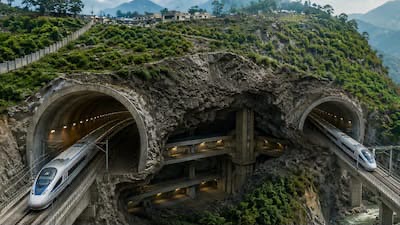
New Delhi: Indian Railways has achieved a major breakthrough in the 125-km Rishikesh-Karnaprayag railway project in Uttarakhand, completing the excavation breakthrough of the 6.59-km Tunnel-14 in Rudraprayag district. The development marks an important step towards improving connectivity to the Himalayan region and making journeys to popular pilgrimage destinations, including Kedarnath and Badrinath, more convenient.
The tunnel connects two excavated sections measuring 4.7 km from Portal-1 at Sumerpur and 1.79 km from Portal-2 at Marora.
Construction teams faced several engineering challenges while working on the tunnel. At Portal-1, workers had to excavate a 110-metre stretch of a three-track tunnel through unstable soil beneath residential areas, with only 20 to 30 metres of earth and rock above it.
Specialised construction techniques, including pre-excavation and multi-drifting, were adopted to ensure safe excavation through the difficult geological conditions.
At Portal-2, engineers strengthened the slope using micropiles extending 30 to 35 metres underground, rock bolts measuring 15 to 20 metres and consolidation grouting. These measures helped address ground settlement concerns at Marora and enabled the main tunnel excavation to begin in March 2024 after resolving land and property acquisition issues.
Around 100 metres of mechanical excavation was also carried out at Portal-2. Controlled blasting was undertaken exclusively during daytime near both tunnel portals to minimise risks to nearby residential settlements.
Specialised ventilation systems were installed throughout the 4.7-km excavation stretch from Portal-1 to maintain fresh air circulation and regulate temperatures inside the tunnel.
The Rishikesh-Karnaprayag railway project is a major infrastructure initiative designed to strengthen rail connectivity across Uttarakhand’s mountainous regions.
Once completed, the railway line is expected to make travel easier for pilgrims and tourists visiting important religious destinations while improving accessibility and supporting economic development across the hill districts.