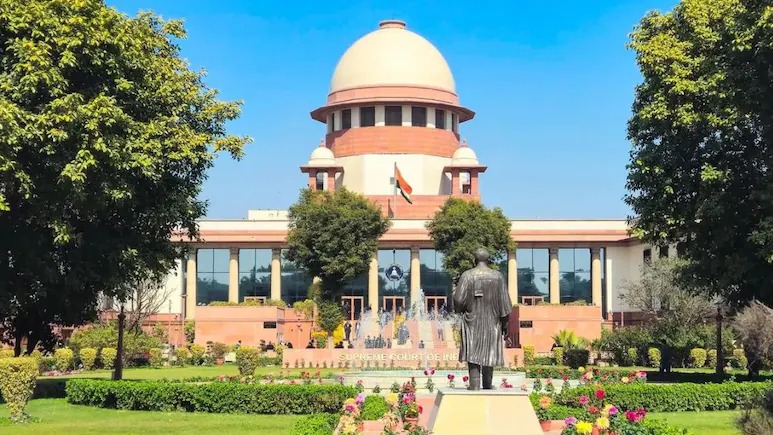
New Delhi: Air pollution in Delhi came into focus during a Supreme Court hearing on Wednesday, with Justice Vikram Nath pointing out that lawyers can avoid exposure by working from home and appearing virtually, while judges must attend court to hear cases in person.
The observation came during proceedings on a petition related to pollution. Senior advocate Indira Jaising requested that the matter be listed on November 17, after Diwali. However, the opposing side pressed for an earlier hearing, citing concerns that pollution levels in Delhi and the surrounding areas could worsen after the festival.
Jaising remarked that pollution remained severe both before and after Diwali and requested a later date. Justice Nath responded that air quality could deteriorate further following the celebrations, making an earlier hearing necessary.
Jaising subsequently noted that she was willing to face the pollution to appear before the court in person, adding that judges would also have to attend proceedings. Justice Nath observed that lawyers had the option of appearing through video conferencing, whereas judges could not simply remain at home.
Delhi witnessed a significant deterioration in air quality around Diwali last year. The city’s 24 hour average Air Quality Index (AQI) rose from 268 on October 18, 2025, to 296 the following day. It reached 345 on Diwali, October 20, before climbing to 351 on October 21 and 353 on October 22. The air quality remained in the very poor category during this period.
This year, the first phase of the Graded Response Action Plan (GRAP) was implemented across Delhi NCR on October 21. Delhi’s average AQI stood at 244 at 2 pm and 245 at 4 pm that day. It was recorded at 197 at 4 pm on October 27 before rising to 228 at 7 am on October 28.
The Supreme Court has been monitoring Delhi NCR’s pollution situation for several years, examining emissions from vehicles, industries, construction dust, stubble burning and garbage burning, along with the use of firecrackers.
The court has repeatedly raised concerns over the enforcement of restrictions on firecrackers. In November 2024, it observed that religious practices should not justify activities that threaten public health and asked authorities to consider a year round ban.
In April 2025, the court declined to relax the restrictions, citing insufficient scientific evidence regarding the pollution reducing benefits of green firecrackers. However, in October 2025, it permitted their sale and use during a limited period around Diwali.
In September 2026, the court clarified that it would neither impose a complete ban nor permit firecrackers to be used throughout the day. It stressed the need to balance religious sentiments with the health risks faced by children, elderly people and those with existing illnesses.
During a hearing on October 12, the court also examined concerns about weak enforcement and emphasised public awareness and voluntary restraint to reduce pollution.
Sorry, there was a YouTube error.