Team Goemkarponn
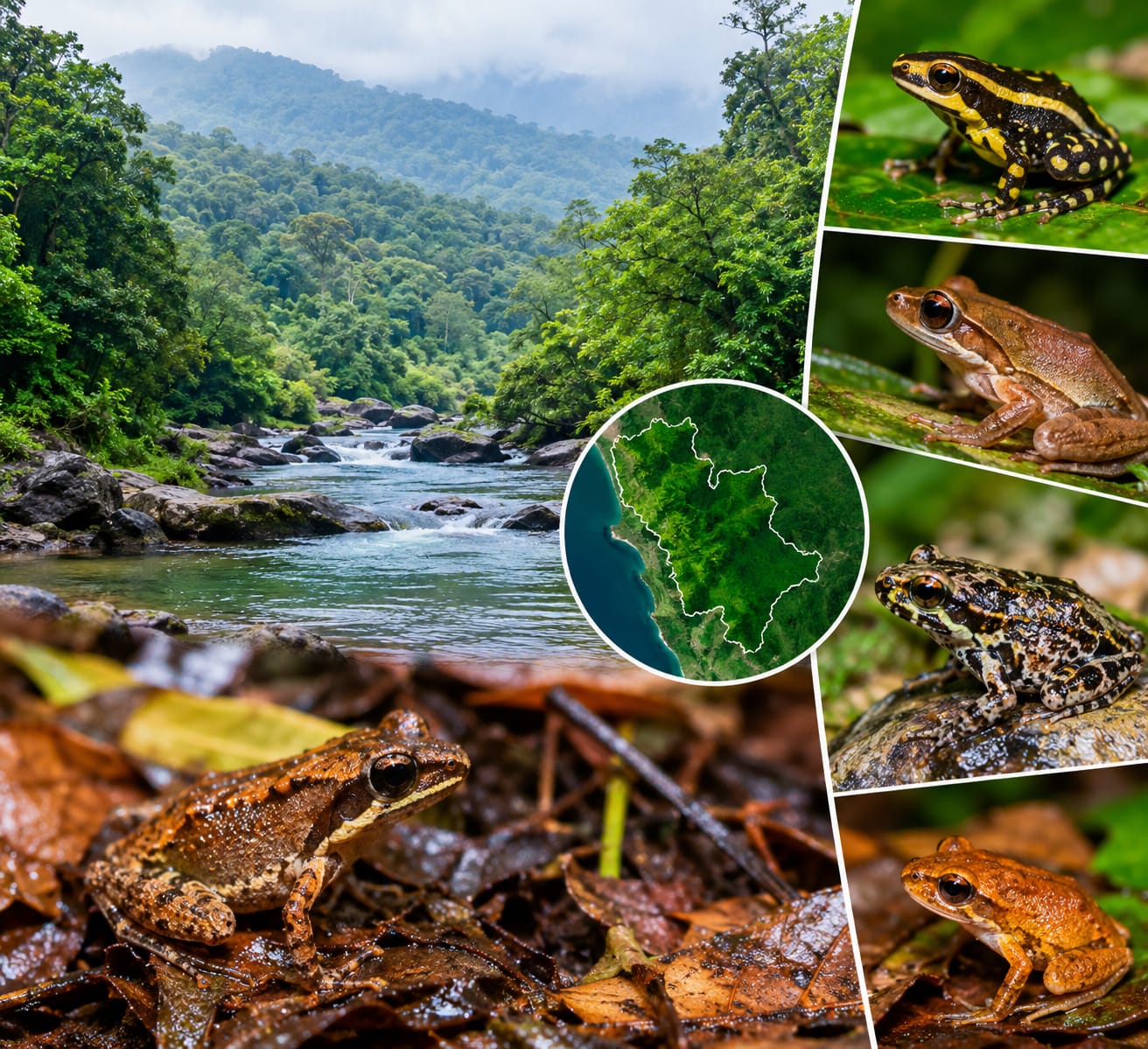
PANAJI: A recent scientific survey has identified the Madhei river-Satrem tributary watershed as the richest amphibian habitat among 12 watershed zones examined across Goa’s Western Ghats.
The watershed, classified as W3 in the study, recorded 19 amphibian species, the highest number documented during the survey. Overall, researchers recorded 22 species from 102 sampling locations, including eight species found only in the Western Ghats.
The study, published in the Journal of Threatened Taxa, examined amphibian diversity across approximately 1,335.95 sq km of Goa’s Western Ghats. The surveyed landscape included the Mhadei Wildlife Sanctuary, Bhagwan Mahavir Wildlife Sanctuary, Mollem National Park, Netravali Wildlife Sanctuary and Cotigao Wildlife Sanctuary.
The findings underline the ecological importance of the Mhadei region, where forest streams and adjoining habitats provide suitable conditions for amphibians. The results are also relevant to the continuing debate over the proposed diversion of the Mhadei river by Karnataka, with the study documenting the biodiversity value of the river’s forested watershed.
Researchers found that the condition of the forest floor was particularly important for amphibian populations. Leaf-litter depth emerged as the strongest environmental factor associated with species diversity, while greater humidity was also linked to higher species richness. In contrast, amphibian diversity tended to decrease as temperatures increased.
The survey showed that watersheds with roughly 80 to 95 per cent canopy cover, combined with deeper leaf litter, generally supported more amphibian species. Researchers cautioned that maximum canopy density does not automatically provide the most favourable habitat, as dense vegetation can affect the structure of leaf litter and temperature conditions near the ground.
Across the 12 watersheds, the number of recorded amphibian species ranged from nine to 19, placing the Madhei-Satrem watershed at the top of the diversity scale.
The researchers stressed that maintaining natural leaf-litter layers and a variety of forest structures will be important for amphibian conservation. Such measures could be particularly significant around streams in the Western Ghats, where habitat fragmentation and climate-related changes are putting additional pressure on sensitive species.
The study describes the results as evidence of the conservation importance of mid-successional forest areas, particularly in a biodiversity hotspot such as the Western Ghats where natural habitats continue to face alteration.