Team Goemkarponn
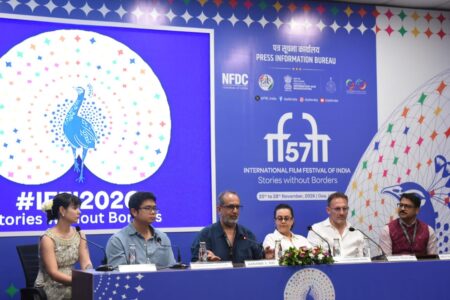
PANAJI: Renowned filmmaker Karthik Subbaraj explored the complexities of morality, the roots of villainy in society and cinema’s potential to challenge prejudice during an interactive session titled ‘What If the Villain Is Right?’ at the 57th International Film Festival of India (IFFI) in Goa.
Moderated by film critic Sudhir Srinivasan, the session examined how Subbaraj’s films question conventional distinctions between good and evil. Observing that human behaviour is shaped by circumstances and social experiences, the filmmaker remarked, “The base is grey for everyone.”
Discussing his film ‘Dorothy’, Subbaraj distinguished between characters who consciously commit evil and those whose harmful behaviour emerges from deeply ingrained social conditioning. He pointed out that individuals who fail to recognise their own prejudices and wrongdoing can sometimes be more dangerous than those who openly display evil tendencies.
Subbaraj explained that ‘Dorothy’ portrays masculinity and patriarchal attitudes as the forces responsible for the protagonist’s death, suggesting that an oppressive mindset, rather than a single individual, is the real antagonist. Drawing a parallel with his film ‘Mercury’, he discussed how the collective mentality of a village can also become a source of villainy.
Reflecting on humiliation and accountability, the filmmaker observed that ridicule and laughter directed at someone’s inability can sometimes be more hurtful than reprimand. He also highlighted remorse and guilt as forms of punishment, noting that the consequences of one’s actions need not always involve physical harm or death.
Speaking about cinema’s ability to influence society, Subbaraj recalled audience reactions to ‘Dorothy’, including instances where viewers embraced transgender people and men were moved to tears. Such responses, he said, strengthened his belief that cinema can go beyond entertainment to foster empathy and encourage social change. He added that the idea of bringing about change through storytelling had also influenced his approach to ‘Jigarthanda’.
The filmmaker emphasised that he does not believe in portraying characters as completely virtuous heroes or irredeemably evil villains. Instead, he prefers leaving moral judgments open to interpretation, allowing audiences to examine characters and their motivations from different perspectives.
The discussion highlighted Subbaraj’s cinematic approach, where villainy is often rooted not merely in individuals but in the social attitudes and structures that shape them. His reflections underscored cinema’s ability to challenge conventional notions of good and evil, question ingrained prejudices and encourage greater empathy.
Resonating with IFFI 2026’s theme, ‘Stories Without Borders’, the session highlighted how stories rooted in specific social and cultural realities can raise universal questions about morality, empathy and human behaviour.