TEAM GOEMKARPONN
PANAJI: Goa’s ambitious AI-powered border surveillance system, introduced to monitor vehicles entering and leaving the State, is facing questions over its operational efficiency following concerns about delayed salary payments to personnel responsible for running the system.
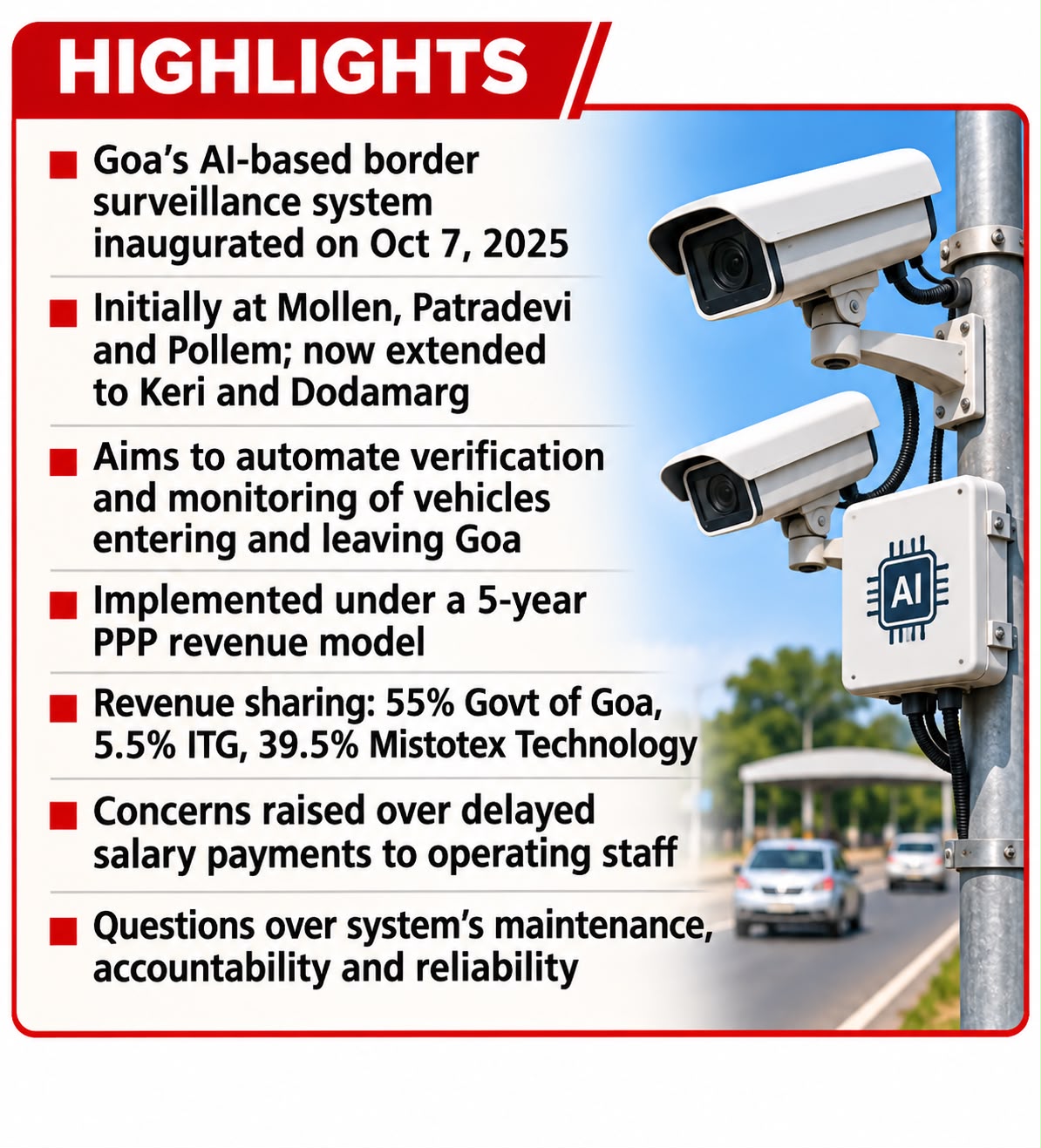
The pilot project was officially inaugurated on October 7, 2025, at the Mollen, Patradevi and Pollem border checkposts. Subsequently, the system was extended to other border areas, including Keri and Dodamarg.
The primary objective of the project is to automate the verification and monitoring of vehicles entering and exiting Goa, strengthening surveillance and improving enforcement at the State’s entry and exit points.
However, concerns over timely salary payments to employees operating the system have raised questions about how effectively the surveillance network can function if the personnel responsible for its day-to-day operations are not paid on time.
According to information available, the project is being implemented under a five-year Public-Private Partnership (PPP) Revenue Sharing Model.
Under the agreement, the revenue is distributed as follows:
* 55 per cent: Government of Goa
* 5.5 per cent: Information Technology Agency of Goa (ITG)
* 39.5 per cent: Mistotex Technology
While a multi-crore arrangement has been put in place for an AI-based border surveillance network, the alleged salary payment delays have brought the human resource component of the project into focus.
The issue is significant because the government has entrusted this technology with monitoring vehicle movement across Goa’s borders. While artificial intelligence can scan number plates, identify vehicles and generate surveillance data, trained personnel remain essential to operate the system, monitor its performance, address technical glitches and ensure regular maintenance.
This raises an important question: who will take responsibility if the system stops functioning because of operational or maintenance-related problems?
More importantly, if a vehicle enters Goa while the automated surveillance system is non-operational, how will authorities trace its movement and establish whether it entered during the period when surveillance was down?
Goemkarponn News had earlier highlighted an incident involving a Karnataka-registered vehicle that allegedly entered Goa with an improper number plate and fully tinted windows. Following the report, the Directorate of Transport initiated action in the matter.
The incident had already raised questions about the effectiveness of vehicle monitoring and enforcement at Goa’s border checkposts.
The latest concerns over salary payments have added another dimension to the debate surrounding the reliability of the surveillance network.
The government and the agencies involved must clarify whether employees are receiving their salaries regularly and what safeguards are in place to ensure uninterrupted functioning of the system.
After all, border surveillance is not merely about installing cameras and deploying artificial intelligence. It is about ensuring that the entire network remains functional, accountable and effective at all times.
AI may watch Goa’s borders, but without people to operate and maintain it, even the most advanced surveillance system risks becoming ineffective.