Team Goemkarponn
Team Goemkarponn
PANAJI: Is the long-running political unease between Chief Minister Dr Pramod Sawant and Health Minister Vishwajit Rane finally behind the BJP, or has the party leadership once again stepped in to contain differences between two of its most influential leaders in Goa?
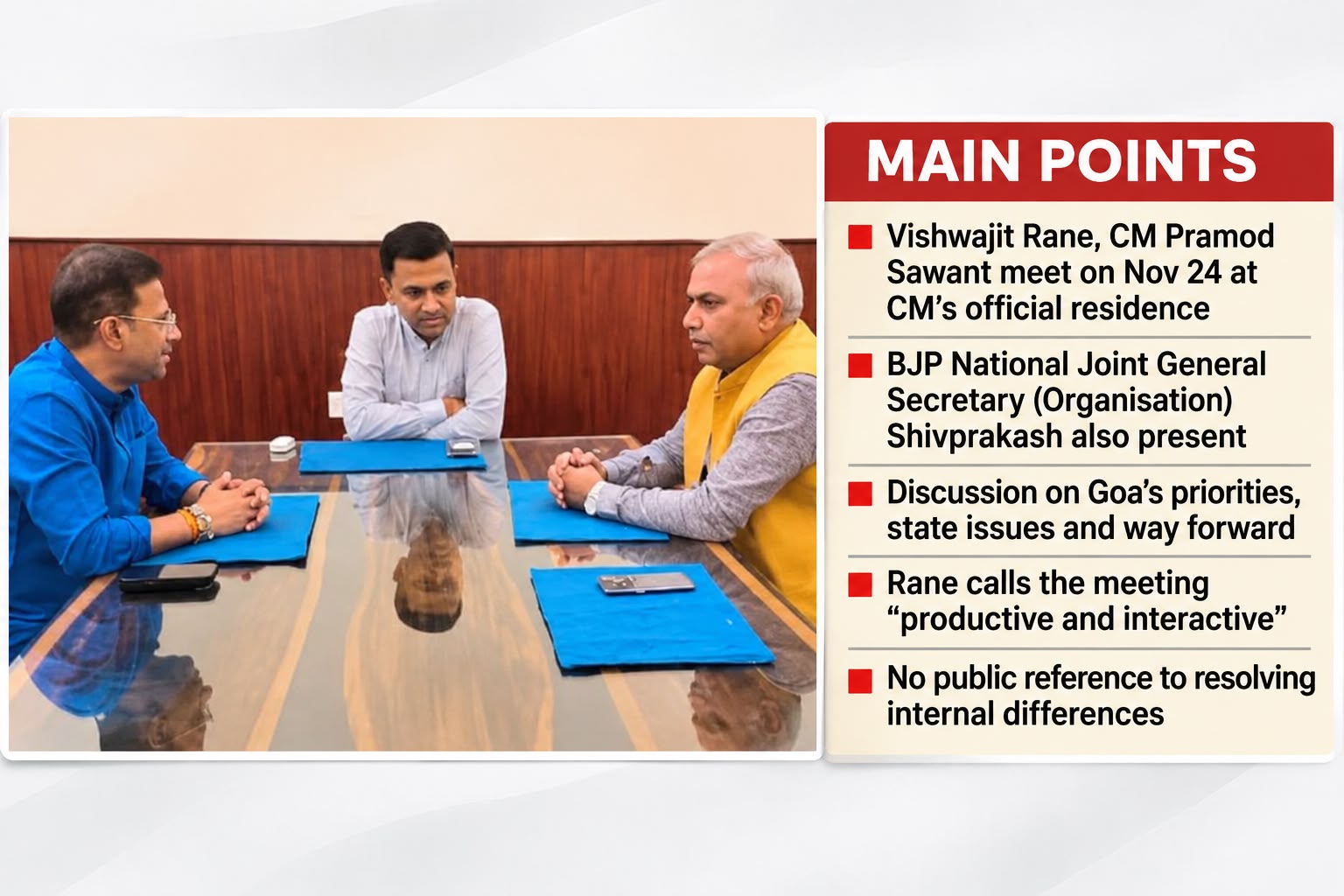
A meeting between Sawant and Rane at the Chief Minister’s official residence on November 24, in the presence of BJP National Joint General Secretary (Organisation) Shivprakash, has brought the question of internal unity back into focus.
Rane subsequently described the meeting as “productive and interactive”, stating that discussions centred on important matters concerning Goa, its priorities and the way forward for the state.
Significantly, his public statement made no reference to internal differences, reconciliation or any specific political understanding between the two leaders.
However, the presence of Shivprakash, a senior BJP organisational functionary, alongside the Chief Minister and Health Minister has inevitably drawn attention. The meeting comes against the backdrop of a history of political friction between Sawant and Rane, which has periodically surfaced in public and required intervention from the party’s central leadership.
For the BJP, the timing is important. With the 2027 Assembly elections approaching, the party has little room for prolonged public disagreements between two senior leaders who occupy important positions in its Goa establishment.
But whether the November 24 meeting has addressed the underlying issues remains unclear.
A rivalry that goes back several years
The relationship between Sawant and Rane has been under scrutiny since Rane joined the BJP in 2017 after resigning from the Congress-led government. Both leaders have political influence in the Sattari belt, and questions over their respective positions within the party have repeatedly surfaced.
The most serious public confrontation came during the second wave of the COVID-19 pandemic in May 2021, when Goa was struggling with an acute oxygen supply crisis at the Goa Medical College and Hospital.
On May 11, 2021, Rane publicly stated that 26 COVID-19 patients had died between 2 am and 6 am, raising concerns about inadequate oxygen supplies. He also called for a High Court-monitored investigation and suggested that the Chief Minister might have been misinformed about the situation. Goa News – The Indian Express +1
The remarks exposed differences within the government at a time when the administration was facing intense public scrutiny over its handling of the pandemic.
The following day, BJP state president Sadanand Tanavade facilitated a meeting between Sawant and Rane at the Chief Minister’s residence. The Goan reported on May 13, 2021, that the party’s central leadership had intervened in an attempt to defuse tensions between the two.
The party publicly maintained that there were no differences, even as reports suggested that the intervention was necessary to prevent the situation from escalating. The Goan +1
The oxygen controversy also produced conflicting public positions. While Rane initially highlighted the shortage and sought an inquiry, he subsequently told the Assembly in July 2021 that no COVID-19 patient had died directly because of oxygen shortage. The Bombay High Court had earlier observed that there were serious issues concerning oxygen supply at GMC and that lessons needed to be learnt from the deaths. Goa News – The Indian Express +1
Denials of differences, but questions never disappeared
The tensions did not end with the pandemic.
In November 2021, when BJP national president J P Nadda visited Goa, Sawant publicly dismissed reports of a fight between the two leaders, saying they were united.
However, a meeting in Valpoi attended by Nadda reportedly exposed continuing differences. According to The Goan’s November 26, 2021 report, while Sawant spoke about unity, Rane suggested that certain outstanding issues could be discussed in the absence of the national leader. Goa News – The Indian Express +1
The political undercurrents became particularly visible again in March 2022, when the BJP returned to power following the Assembly elections.
Both Sawant and Rane travelled to Delhi for discussions with the party’s central leadership. Rane was widely discussed as a possible contender for the Chief Minister’s post, although he publicly dismissed speculation about seeking the position. The central leadership eventually retained Sawant as Chief Minister. The Indian Express +1
This episode reinforced the perception that the relationship was not merely about differences over administration but also involved questions of political standing and influence within the BJP.
In October 2023, Hindustan Times published an extensive account of the political relationship, detailing how Rane had backed candidates against Sawant in local-level elections and how the rivalry had periodically surfaced despite public denials by both leaders. Hindustan Times
Central leadership’s continued involvement
The involvement of senior national leaders in attempts to maintain coordination between the two is an important recurring feature of this relationship.
In October 2021, a report by India Today described factionalism within the Goa BJP, noting that ministers, including Rane, had raised complaints about Sawant’s functioning during a meeting with Union Home Minister Amit Shah. India Today
The November 24 meeting, therefore, cannot be viewed in isolation from this history.
Shivprakash’s presence is politically significant, although there is no official confirmation that he attended specifically to mediate between the Chief Minister and Health Minister. Equally, there is no public evidence that the meeting was convened to settle a particular dispute.
Rane’s carefully worded social media statement speaks of Goa’s priorities and development, rather than any political differences. Sawant too has not publicly announced any agreement or reconciliation arising from the meeting.
Unity on camera, but what about the ground?
For the BJP, the bigger challenge is ensuring that public displays of togetherness translate into effective coordination within the government and the party organisation.
Both leaders have repeatedly projected unity whenever speculation about their relationship has gained momentum. Yet the recurring need for senior party interventions raises questions about whether the underlying differences have been adequately addressed.
The BJP is heading towards another crucial Assembly election in 2027. Sawant remains the Chief Minister and the party’s principal face in the government, while Rane is an influential minister with considerable political standing in his constituency and within the state unit.
The party would naturally want both leaders to work together rather than allow competing political ambitions or administrative disagreements to become public controversies.
But political photographs and carefully worded statements cannot, by themselves, establish that differences have disappeared.
The November 24 meeting may have been an attempt to reinforce coordination, discuss the party’s priorities and send a message that its senior leadership is working together. Whether it has achieved something more substantial will become apparent through their conduct in the coming months.
There are several questions the BJP leadership needs to answer. Have the two leaders agreed on a common approach to governance? Have disagreements over administrative decisions and political influence been addressed? Is there a clear understanding of their respective roles ahead of the 2027 elections?
For now, the meeting has generated more questions than answers.
The BJP may want the public to believe that all is well within its Goa leadership. But the history of the Sawant-Rane relationship suggests that declarations of unity have surfaced before, often following periods of visible friction.
The real test of November 24 will not be what was discussed over the meeting table, but whether the two leaders can demonstrate sustained political and administrative coordination without requiring another intervention from Delhi.
Editorial desk note: The report distinguishes documented past confrontations from the unconfirmed purpose of the November 24 meeting. The headline raises the question of a last-ditch effort, but the story does not present reconciliation as an established fact.