New Delhi: China has reportedly developed hypersonic glide vehicles capable of launching air to air weapons against high value aircraft at extremely long distances, marking a significant expansion of Beijing’s missile capabilities.
The reported weapons could threaten aircraft such as aerial refueling tankers, airborne early warning and control aircraft and airborne command posts. One particularly important potential target is the US Air Force’s E 4B Nightwatch, which serves as a flying command center during major military operations.
China is also believed to be integrating air to air capabilities into certain hypersonic cruise missiles while developing anti ship functions for other missile systems. The developments reflect Beijing’s broader effort to expand the roles of its rapidly growing missile arsenal.
A hypersonic glide vehicle is launched by a missile and then travels through the atmosphere at extremely high speeds while retaining the ability to maneuver. This combination can increase range and make interception more difficult.
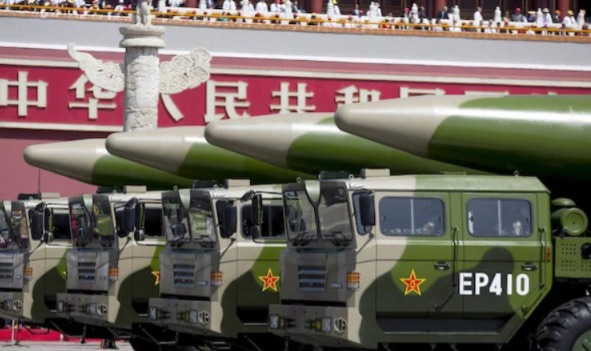
China’s DF 17 system is estimated to provide a range of around 2,414 kilometres, while the more advanced DF 27 is believed to have a potential range of about 8,000 kilometres. Such capabilities could place distant targets across the western Pacific and potentially as far as Hawaii within reach.
However, using ballistic missile derived weapons against moving aircraft presents major operational challenges. Successful attacks would require precise and continuously updated information from distant sensors. Any disruption to this targeting chain could reduce effectiveness.
There is also a serious escalation risk. A ballistic missile launch could be difficult to distinguish from a nuclear strike, creating the possibility of miscalculation during a major conflict.
China’s expanding missile force comes as militaries increasingly focus on long range air to air weapons. The United States and other countries are also developing missiles designed to engage aircraft at hundreds of miles, highlighting the growing importance of long distance aerial warfare.
Sorry, there was a YouTube error.