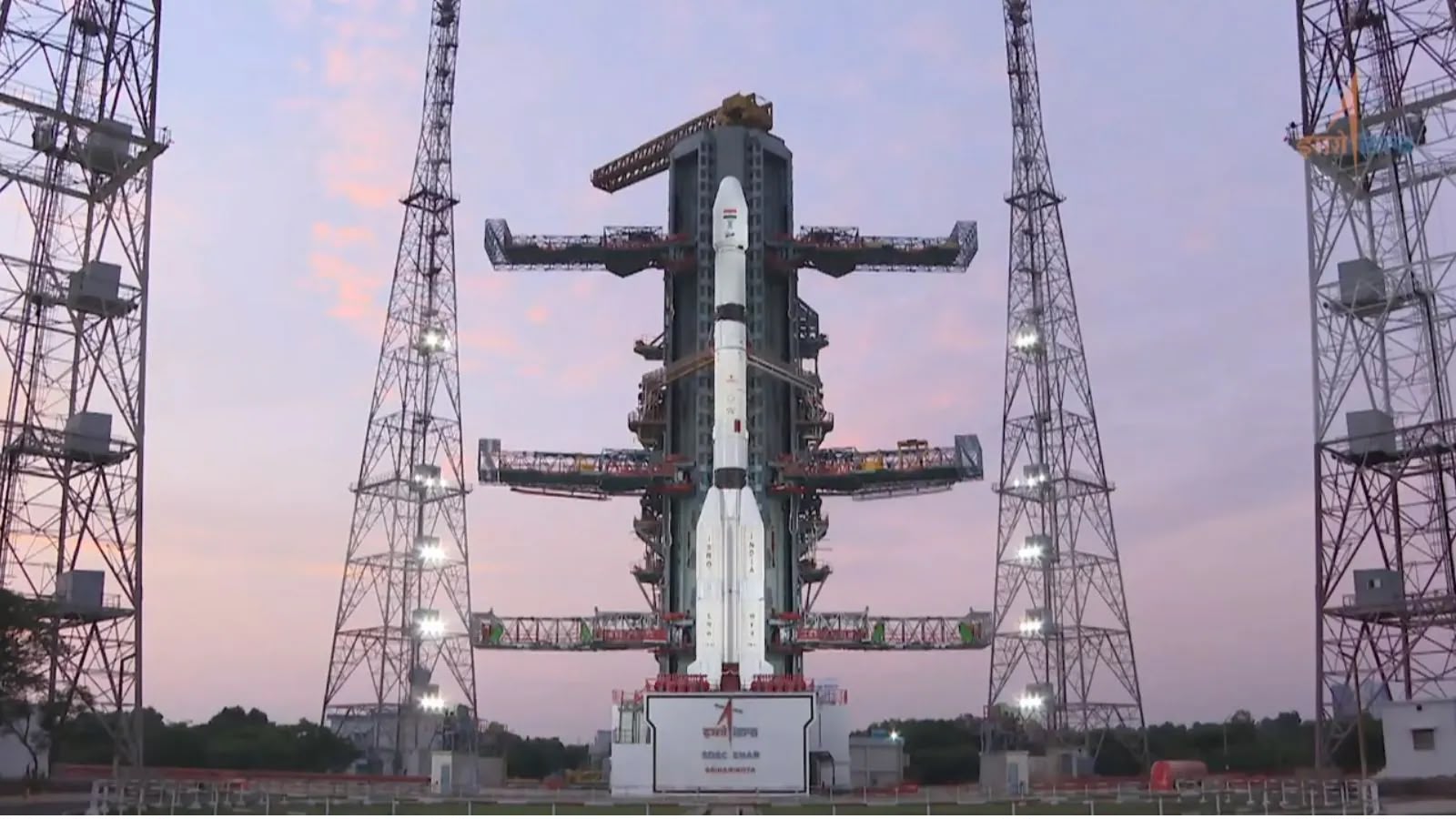
New Delhi: India’s space programme achieved a significant milestone on Friday night as the Indian Space Research Organisation (ISRO) successfully launched the NVS-03 navigation satellite aboard its Geosynchronous Satellite Launch Vehicle, GSLV-F18, from Sriharikota at 11:51 pm.
The mission is an important step towards strengthening India’s indigenous Navigation with Indian Constellation (NavIC) system, which provides positioning, navigation and timing services for civilian and strategic applications.
ISRO Chairman V. Narayanan confirmed that the satellite had been placed precisely into its intended elliptical orbit. The mission also brings India closer to its ambition of achieving “One Nation, One Time” through reliable, indigenous navigation and timing infrastructure.
Prime Minister Narendra Modi congratulated ISRO on the achievement, highlighting the satellite’s enhanced capabilities and its contribution to self-reliance in critical technologies.
NVS-03 is the third satellite in the second generation of India’s Navigation Satellite Series and the twelfth spacecraft associated with the Indian Regional Navigation Satellite System. It is designed to strengthen the existing constellation, improve reliability and expand the capabilities of NavIC, India’s alternative to the American Global Positioning System (GPS).
NavIC was developed to provide independent navigation services across India and approximately 1,500 kilometres beyond its borders. The system offers standard positioning services for civilian users and restricted services for authorised strategic applications.
However, the programme has faced challenges in recent years, with failures involving atomic clocks affecting the operational capabilities of several satellites. These clocks are essential for precise positioning because even tiny timing errors can affect navigation accuracy.
NVS-03 carries an indigenous atomic clock alongside procured clocks, marking progress towards reducing dependence on foreign technology for critical satellite components. The second generation of navigation satellites is also introducing the L1 frequency, expanding compatibility with devices and applications such as smartphones, transportation and aviation.
The mission carries additional strategic importance following concerns over gaps in India’s navigation infrastructure. A fully operational NavIC constellation is essential for strengthening national security, military operations and critical services.
With NVS-03 in orbit, the constellation is supported by four navigation satellites, while further launches, including NVS-04 and NVS-05, are expected to help modernise the network and move it towards its planned seven satellite configuration.
The launch also highlights the progress of the GSLV Mk II, once nicknamed ISRO’s “naughty boy” because of its history of failures and technical challenges, particularly involving cryogenic propulsion. Continued engineering improvements have enhanced the rocket’s reliability and performance.
Standing nearly 50 metres tall and weighing approximately 420 tonnes at liftoff, the launch vehicle successfully delivered another crucial mission.
The successful deployment of NVS-03 marks another step in India’s efforts to build a dependable, self reliant navigation system and strengthen its strategic capabilities in space.