Team Goemkarponn
NARVEM: Chief Minister Dr Pramod Sawant on Friday said Goa could have had temples similar to those seen in South India if the Portuguese had not arrived in the state.
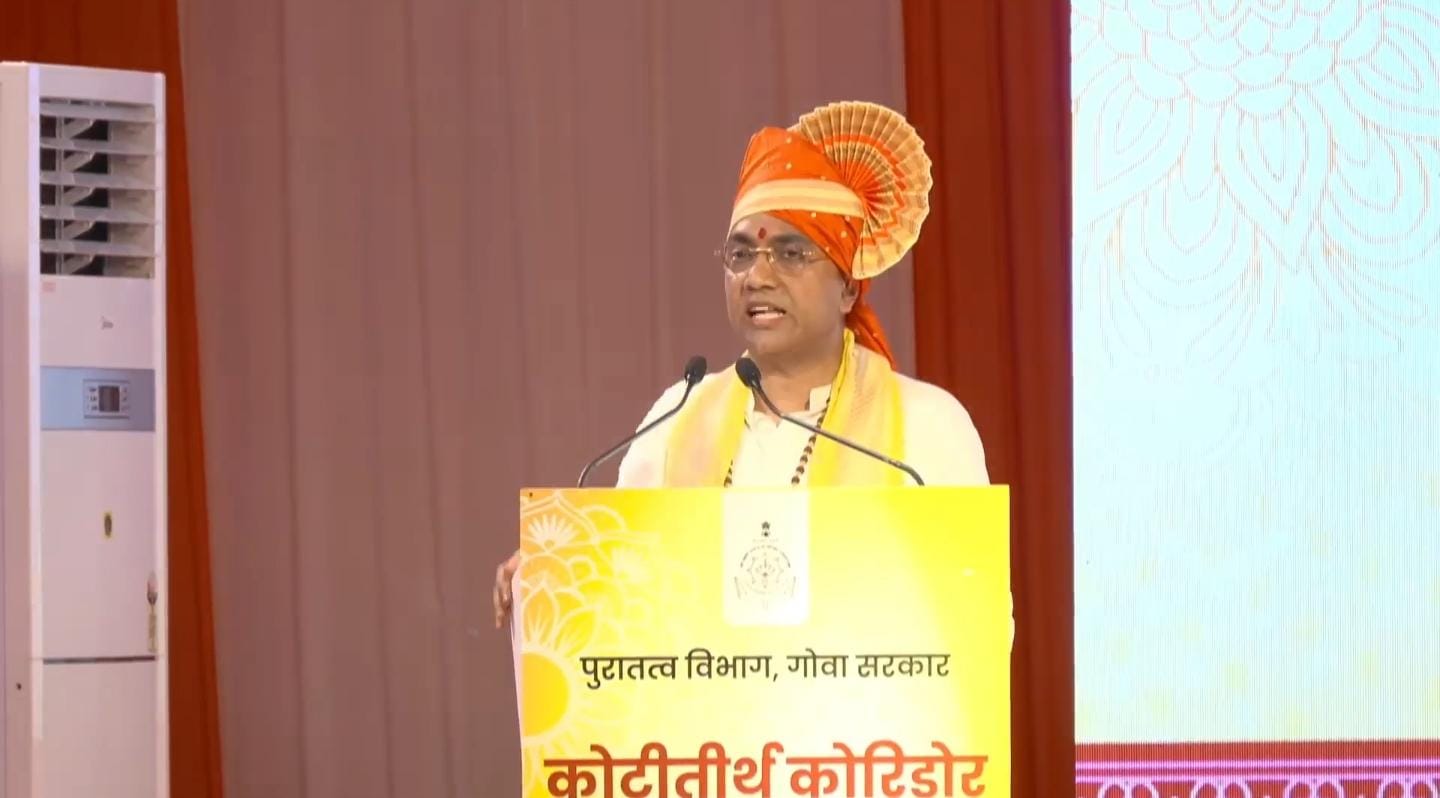
Speaking at the Udak Shanti and Ganga Pujan ceremony at the Koti Tirth Corridor project at Divar, Sawant said Goa had been ruled by around 8–10 kingdoms and described the Kadamba period as a “golden era” in the state’s history.
He said the Kadamba rulers, along with Goans, built several temples across Goa. However, many temples were later destroyed during Portuguese rule.
“If Portuguese would have not come to Goa, we would have seen temples in Goa similar to those in South India,” Sawant said.
Koti Tirth Corridor To Be Completed Within One Year
Sawant said the Koti Tirth Corridor project will be completed within one year. The restoration of Shree Saptakoteshwar and Kotiteerth, described as symbols of Goa’s ancient religious, cultural and historical heritage, has commenced as part of the Directorate of Archaeology’s Kotiteerth Corridor Development Project.
The programme at Pornem Teerth, Divar, included Mahabhishek, Udakshanti, Mandovi Panchganga Aarti and a public meeting. The programme was held in the presence of Chief Minister Dr Pramod Sawant and Union Minister of State Shripad Naik.
Revival Of Ancient Pilgrimage Heritage
According to the government, Goa has historically been a centre of pilgrimage, learning, trade and culture. The region has been associated with several dynasties, including the Mauryas, Satavahanas, Bhojas, Chalukyas, Rashtrakutas, Kadambas and Vijayanagara.
The government statement highlighted the Kadamba period as a particularly significant phase in Goa’s history, with Shree Saptakoteshwar being the family deity of the Kadambas.
The temple of Shree Saptanath-Saptakoteshwar at Divar was an important part of this tradition. Following its destruction during invasions, the tradition was carried forward at Narve. Chhatrapati Shivaji Maharaj restored the temple of Shree Saptakoteshwar in 1668.
The Divar-Narve region was also an ancient pilgrimage centre associated with the confluence of the Mandovi and Zuari rivers. Kotiteerth, with its sacred water tank surrounded by 108 Devakoshtas, remains an important remnant of the region’s religious and architectural heritage.
Portuguese Rule And Temple Destruction
The government statement said that after the establishment of Portuguese rule in Goa in 1510, several temples, pilgrimage centres and religious traditions suffered a setback. The temple of Shree Saptakoteshwar at Divar was also destroyed.
Despite this, the government said traditions such as the Gokulashtami pilgrimage, devotion and cultural memory continued to survive.
The State Government has now undertaken the restoration of Shree Saptakoteshwar Temple and Kotiteerth, describing the initiative as more than the restoration of a temple and as an effort to revive ancient pilgrimage traditions, knowledge traditions and the cultural memory of Gomantak.
Gopakapattana Port To Be Developed
Sawant also said the ancient and historic Gopakapattana port in the St Andre constituency will be developed in the future.
He highlighted Goa’s history as an ancient centre of maritime trade and said the state’s identity should not be limited to the description of “Rome of the East”.
The government statement described Goa as the land of Parashurama, a sacred land of pilgrimage and temples, a centre of Vedic and Sanskrit learning, the land of Kadamba glory and an ancient centre of maritime trade. It proposed “Kashi of India on the Western Coast” as a more appropriate identity for Goa.
The Directorate of Archaeology and the Shree Saptakoteshwar-Kotiteerth Restoration Committee have appealed to people to participate in the restoration initiative and support the preservation and revival of Goa’s religious, cultural and historical heritage.