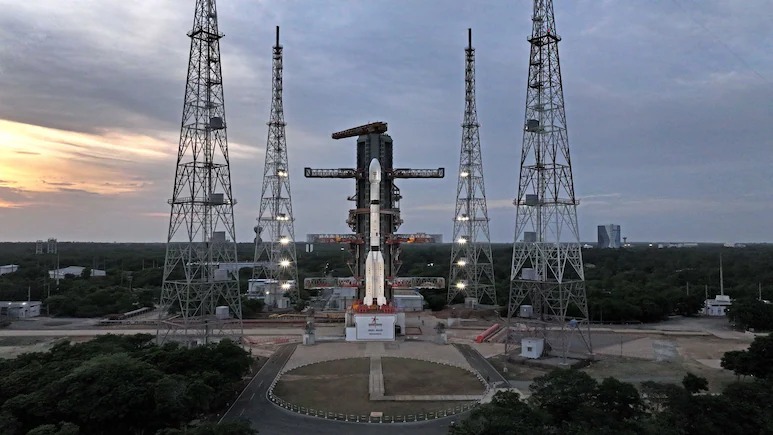
Sriharikota: When most of India is asleep in the early hours of September 4, the Indian Space Research Organisation will face a crucial test of reliability as its Geosynchronous Satellite Launch Vehicle GSLV-F17 prepares to lift off with EOS-5.
The launch is scheduled for 2:55 am from the Second Launch Pad at the Satish Dhawan Space Centre in Sriharikota. Beyond placing an advanced Earth observation satellite into orbit, the mission carries added significance for ISRO after a difficult period involving consecutive PSLV setbacks.
EOS-5 will be India’s first imaging satellite designed to operate from geosynchronous orbit, nearly 36,000 km above Earth. From this position, the spacecraft is expected to provide a continuous view of India and surrounding areas, offering valuable capabilities for weather monitoring, disaster management, environmental observation and strategic surveillance.
The mission is being carried out using the GSLV Mk II, a launch vehicle that operates independently of the PSLV’s propulsion architecture. This means the recent problems associated with the PSLV do not directly affect the GSLV-F17 mission.
However, the GSLV has a complicated history of its own. Nicknamed the “naughty boy” within ISRO because of its unpredictable early record, the launcher experienced six unsuccessful missions among its first 18 flights. Its development was closely tied to India’s long struggle to master cryogenic propulsion.
During the 1990s, international restrictions complicated India’s efforts to obtain cryogenic technology from Russia. ISRO subsequently pursued indigenous development, eventually mastering the highly complex technology involving liquid hydrogen and liquid oxygen at temperatures below minus 250 degrees Celsius.
The GSLV’s journey also includes a major setback involving a similar mission. In August 2021, GSLV-F10 failed to place EOS-03 into orbit after its cryogenic upper stage malfunctioned during flight.
EOS-5 now represents an opportunity to revisit that mission objective with a more advanced spacecraft.
Weighing about 2,367 kg, EOS-5 will initially be placed into a Sub Geosynchronous Transfer Orbit before reaching its operational position. Its continuous observation capability could support monitoring of cyclones, cloud systems, floods, droughts, forest fires, environmental changes and critical infrastructure.
The GSLV-F17 itself stands 51.7 metres tall and weighs around 420.5 tonnes at liftoff. Its three-stage configuration combines a solid core with liquid-fuel strap-on boosters, a liquid-propelled second stage and an indigenous cryogenic upper stage.
The GSLV has also earned renewed confidence through major missions, including the launch of NISAR, a highly advanced Earth observation satellite developed jointly by India and the United States.
Now, attention turns to EOS-5.
A successful GSLV-F17 mission would not simply add another satellite to India’s growing space assets. It would demonstrate the resilience of India’s launch programme and provide an important confidence boost after recent setbacks.
For the “naughty boy”, September 4 could be another defining night in its long and eventful journey.