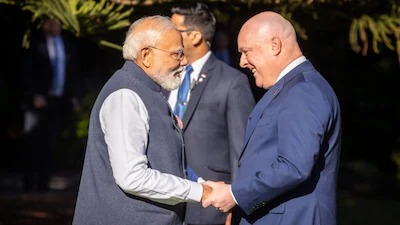
New Delhi: Prime Minister Narendra Modi’s landmark visit to New Zealand has ushered in a new phase in bilateral relations, with the two countries formally elevating their engagement to a Strategic Partnership and adopting an ambitious Roadmap to 2030. The announcement followed delegation level talks with New Zealand Prime Minister Christopher Luxon in Auckland during Modi’s first visit to the country, marking the first trip by an Indian Prime Minister to New Zealand in four decades.
Describing the development as more than a diplomatic achievement, PM Modi said the upgraded partnership represents a shared commitment to shaping the future of both nations. The Roadmap to 2030 outlines cooperation across trade, investment, security, agriculture, clean energy, innovation, education, tourism and cultural exchanges.
A key objective of the agreement is to double bilateral trade in goods and services to NZD 7 billion, approximately Rs 35,000 crore, by 2030. Both countries also agreed to implement the Authorised Economic Operators Mutual Recognition Arrangement, which is expected to simplify customs procedures and speed up cargo clearance for trusted businesses.
New Zealand also announced plans to invest 20 billion US dollars in India over the next 15 years, reflecting growing confidence in India’s long term economic prospects. The leaders also reaffirmed their commitment to the recently signed India New Zealand Free Trade Agreement, which is expected to boost market access, investment and technology cooperation while accelerating trade growth.
Improving connectivity emerged as another priority, with both sides encouraging airlines to launch direct non stop flights between India and New Zealand. The move is expected to strengthen tourism, business travel and people to people ties, particularly benefiting the large Indian community in New Zealand.
The partnership also expands cooperation in agriculture through joint initiatives in horticulture, dairy, animal husbandry and agricultural technology. New Zealand will support productivity programmes for kiwifruit, apples and honey, while Centres of Excellence for kiwifruit cultivation will be established in India.
Beyond economic ties, the two countries agreed to deepen cooperation in maritime affairs and the Indo Pacific region. Plans include improving recognition of Indian seafarer certifications, enhancing maritime collaboration and strengthening engagement on regional security and stability, underscoring a broader strategic vision for the relationship through 2030.
Sorry, there was a YouTube error.