Team Goemkarponn
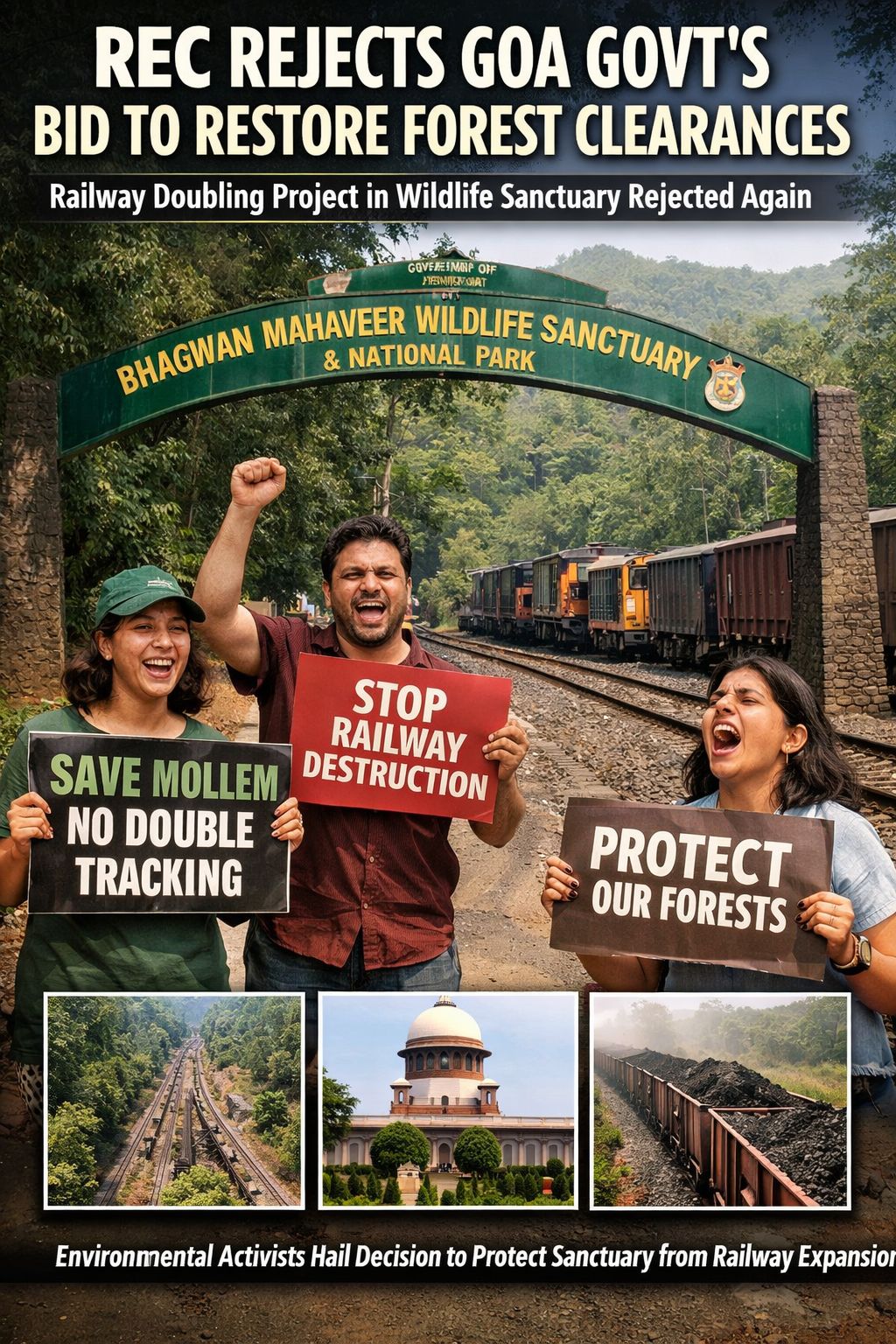
Panaji: The Regional Empowered Committee (REC) has rejected the Goa government’s latest request to revoke the suspension of forest clearances for the controversial railway doubling project passing through the Bhagwan Mahaveer Wildlife Sanctuary and Mollem National Park.
The decision, taken at the REC meeting on March 26, 2026, marks the third time the panel has turned down attempts by the state government, acting on behalf of the South Western Railway and Rail Vikas Nigam Limited (RVNL), to revive clearances for the project.
The railway doubling proposal, covering the Castle Rock–Kulem stretch, had earlier received wildlife clearance from the National Board for Wildlife. However, following a petition by the Goa Foundation, the Central Empowered Committee recommended cancellation of the clearance. The Supreme Court accepted this recommendation in May 2022, leading the Ministry of Environment, Forest and Climate Change (MoEF&CC) to place the project’s forest clearances in abeyance later that month.
Despite multiple efforts by the Goa government to overturn this suspension, the REC has maintained that the project cannot be segmented into smaller stretches to secure approvals. The committee emphasised that the Supreme Court’s ruling must be interpreted in spirit, covering all sections of the project within the protected area, including the Kulem–Kalem stretch.
The REC also noted that the disputed section lies within both the wildlife sanctuary and its eco-sensitive zone, and pointed out that the Goa forest department itself had acknowledged minimal ecological difference between various segments of the project.
In its latest submission, the state government included a cumulative impact assessment conducted by the Wildlife Institute of India (WII), along with a traffic study by RITES. However, the REC flagged serious shortcomings in the WII report, observing that it focused largely on mitigation measures rather than a rigorous evaluation of ecological impacts.
Environmental groups criticised the study for excluding key biodiversity components such as fungi, insects, arachnids and freshwater fish, and for failing to assess ecological functions like wildlife corridors and habitat connectivity. They also pointed to the absence of social impact analysis despite sustained public opposition to the project.
The REC further observed that even the WII report acknowledged that biodiversity losses from the project may not be fully reversible, despite mitigation efforts.
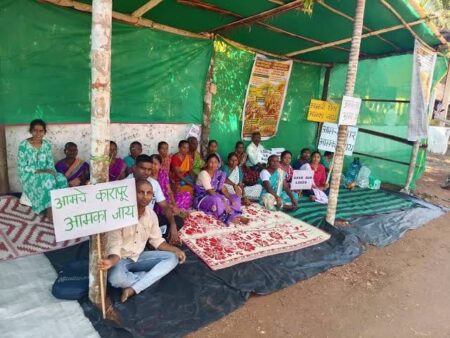
Activists from the Goa Foundation and the Amche Mollem campaign welcomed the REC’s decision, calling it a necessary step to protect forest and wildlife ecosystems. They urged that any future environmental assessment be first reviewed by wildlife authorities before being considered for forest clearance.
The groups also demanded the complete cancellation of existing forest clearances for the project, citing repeated failures to produce a comprehensive environmental assessment.
Beyond ecological concerns, residents along the railway corridor have reported structural damage to homes and socio-cultural sites due to vibrations from train movement. Protests have also continued in coastal areas such as Vasco over coal transportation.
Activists warned that if the railway line cannot pass through protected forests, authorities should reconsider the project in its entirety rather than pursuing partial expansion elsewhere in the state.