Team Goemkarponn
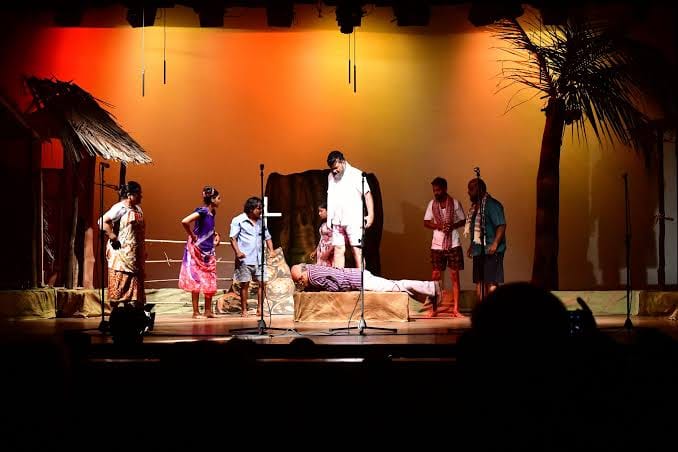
PANAJI: With Tiatr now part of India’s National Inventory of Intangible Cultural Heritage, the focus is shifting towards giving Goa’s distinctive theatre tradition a stronger presence beyond the state and among international Goan communities.
Sangeet Natak Akademi Deputy Secretary (Drama) Suman Kumar has urged the Tiatr Academy of Goa (TAG) and the state government to use the national recognition as a foundation for expanding Tiatr’s academic, cultural and international footprint.
Kumar was speaking during a meeting with a TAG delegation at the Sangeet Natak Akademi in New Delhi on September 10. The meeting was held to discuss the future course of action following Tiatr’s inclusion as the 56th element in the national inventory and the possibility of pursuing UNESCO recognition.
The delegation, headed by TAG President Anthony Barbosa, included Vice-President Marcos Gonsalves and Rajendra Borkar, Officer on Special Duty to Art and Culture Minister Ramesh Tawadkar, among others.
Kumar said the next phase should focus not only on promoting Tiatr but also on ensuring that its traditional character remains protected. He called for the art form to be introduced more extensively in universities, cultural institutions and theatre circles across India.
He also suggested that TAG establish contact with countries where Goan communities continue to stage Tiatr and explore avenues for the art form to receive recognition there.
Such efforts, Kumar said, could help establish Tiatr’s identity as a living cultural tradition with a presence extending beyond Goa and India, potentially adding weight to its future UNESCO recognition efforts.
Emphasising the community’s role in preserving cultural traditions, Kumar said Tiatr had evolved through the contribution of its practitioners and warned against approaches that could dilute its cultural identity.
He cautioned against excessive commercialisation of traditional art forms, arguing that cultural traditions should not be treated solely as marketable products or become vehicles for political interests.
Kumar also proposed strengthening Tiatr’s academic ecosystem. Among his suggestions was the possibility of creating a dedicated Tiatr-related academic centre or institutional presence in Delhi, where researchers, students and theatre practitioners could study the form.
He proposed scholarships for research on Tiatr and collaborations with institutions working in areas such as anthropology, theatre and intangible cultural heritage.
An annual Tiatr festival in Delhi was another suggestion put forward during the meeting. Kumar also proposed comparative academic studies between Tiatr and other Indian theatre traditions and suggested that National School of Drama teams visit Goa to study Tiatr within its traditional environment.
“Let others experience what Tiatr is,” Kumar said, stressing that any expansion of the art form should continue to be anchored in its intangible cultural heritage character.
Barbosa presented an overview of Tiatr’s origins, development and presence among Goan communities worldwide. He also outlined TAG’s work in documentation, research and promotion of the art form.
He said the academy was willing to consider initiatives that could introduce Tiatr to a wider audience without compromising its cultural roots.
“We are open to all suggestions so that Tiatr reaches the maximum number of people, especially at the academic level, while continuing to practise and preserve our culture,” Barbosa said.
Fr Luis Gomes, who is associated with TAG’s Tiatr Academic Study and Knowledge (TASK) committee, along with other members of the delegation, briefed Kumar on the academy’s research work and its research journal.