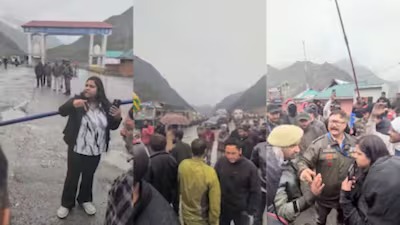
New Delhi: A heated confrontation between a female tourist and security personnel at the Minimarg checkpoint in Ladakh has gone viral, triggering a nationwide debate on public behaviour, border security and the misuse of generational identity. The incident, which took place in July in Kargil’s sensitive border region, drew a sharp reaction from Jammu and Kashmir Chief Minister Omar Abdullah.
Sharing the viral video on social media, Abdullah wrote, “This ‘We are Gen Z’ has become the new ‘Jaante ho mera baap kaun hai’.” He added that the quickest way to erode the goodwill associated with Gen Z is to use the phrase as a threat whenever faced with a perceived inconvenience.
The video shows the woman arguing aggressively with security personnel after traffic was halted for nearly five hours. Repeatedly saying, “We are Gen Z. We are not going to tolerate this nonsense,” she also urged stranded travellers to start their vehicles and leave together. She questioned why tourists were being stopped, saying they paid to visit the region and should not have to tolerate such treatment. In another clip, she claimed that government salaries were funded by taxpayers and insisted that everyone should move together or no one should leave.
According to reports, the delay occurred on July 25 after bad weather forced Defence Minister Rajnath Singh and Army Chief General Dhiraj Seth to change their travel plans. Instead of travelling entirely by air, they proceeded by road from Gumri towards Kargil, leading to temporary traffic restrictions along the Zojila to Gumri route.
The woman’s remarks drew widespread criticism from retired Army officers. Veterans including Lt Gen KJS Dhillon, Lt Gen DP Pandey, Lt Gen Satish Dua and former Army chief Gen VK Singh defended the armed forces, emphasizing that soldiers also pay taxes and serve in extreme conditions to protect the nation. They also criticized her comments about Kashmiris and praised the calm and professional conduct of the uniformed personnel during the confrontation.
The viral episode has since sparked intense discussion online about entitlement, respect for security forces and the realities of travelling through strategically sensitive border areas where operational and safety restrictions are often unavoidable.
Sorry, there was a YouTube error.