Team Goemkarponn
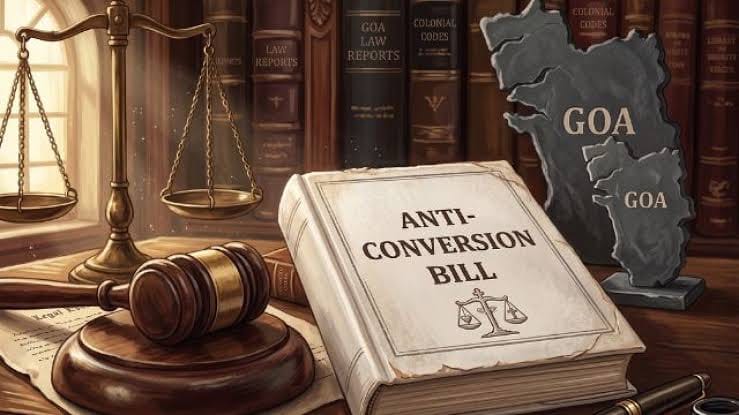
PANAJI: The Goa Government’s decision to introduce the Goa Prohibition of Unlawful Conversion of Religion Bill, 2026 has triggered a broad political and civil society response, with the Congress, Goa Forward Party (GFP), Citizens for Democracy-Goa and church organisations questioning the necessity of a separate anti-conversion law and cautioning against provisions they fear could be open to misuse.
The legislation, cleared by the State Cabinet for introduction in the forthcoming Assembly session, has emerged as a fresh point of political contestation in the state, with its opponents arguing that Goa has not demonstrated a significant problem of forced or fraudulent religious conversions warranting such a law.
Congress president Amit Patkar accused the government of using the proposed legislation to shift attention away from issues confronting the state. He called on Chief Minister Pramod Sawant to make public the data on religious conversions before seeking legislative approval for the bill.
“When the government fails, diversion tactics are used. To divert from the main issues, they are bringing the anti-conversion bill. I condemn it. The CM should first show the figures of conversions,” Patkar said.
Congress Aldona MLA Adv. Carlos Alvares Ferreira said the party would oppose the legislation when it reaches the Assembly. He questioned the government’s justification for introducing the bill, referring to cases previously cited in connection with alleged conversions.
According to Ferreira, three cases had been cited by the government, of which one was closed by the police and two were subsequently quashed by the High Court. He argued that the record did not establish a compelling case for introducing a new law and alleged that the legislation could contribute to communal polarisation.
GFP chief Vijai Sardesai took a similar position, while drawing a distinction between unlawful conversion and legitimate matters of personal faith and choice.
“Forced, fraudulent or coercive conversion must be dealt with firmly under the law. But faith, conscience, marriage and personal choice of consenting adults cannot be criminalised,” Sardesai said.
He questioned the government’s decision to introduce what he described as an extraordinary legislative measure without first placing supporting data and documented cases before the public.
The GFP has sought a Select Committee examination of the bill along with detailed public consultation. Sardesai also raised concerns over provisions reportedly dealing with “undue influence”, “allurement” and conversion through marriage, saying their interpretation would require careful scrutiny to prevent arbitrary application.
Former minister Francisco Xavier Pacheco (Mickky) also criticised the proposed legislation, alleging that its stringent penalties could create fear among minority communities. He argued that the law could have wider social consequences in a state known for its inter-community interactions and religious coexistence.
Beyond the political opposition, Citizens for Democracy-Goa convenor Elvis Gomes has questioned the proposed law within the larger context of Goa’s land and development policies.
In an open letter addressed to Chief Minister Pramod Sawant, PWD Minister Digambar Kamat and GFP MLA Vijai Sardesai, Gomes said there was no empirical evidence publicly establishing widespread coercive religious conversion in Goa. He argued that existing criminal provisions were sufficient to deal with cases involving fraud, intimidation or coercion.
Gomes also called for the withdrawal of the proposed anti-conversion legislation and opposed the use of Section 39A of the Town and Country Planning Act for land conversions, arguing that changes in land use were having significant implications for Goa’s environment, communities and demographic character.
The Council for Social Justice and Peace (CSJP) and the Catholic Association of Goa (CAG) have likewise urged the government to reconsider the legislation.
In a joint statement, CSJP Secretary Fr Savio Fernandes and CAG president Cyril A. Fernandes said the Church opposed conversion through force, fraud, threats or coercion, but maintained that such conduct was already punishable under existing criminal law.
The organisations called for the full draft of the proposed legislation to be made public and sought consultations with religious communities, constitutional experts, civil society organisations and representatives of interfaith families before the bill proceeds.
Particular concern has been expressed over terms such as “allurement” and “undue influence”, with the organisations arguing that provisions lacking clear definitions could potentially lead to complaints against legitimate religious, charitable, educational or medical activities.
The organisations also cautioned that allowing third parties to initiate complaints could result in private religious choices and interfaith relationships becoming the subject of unnecessary intervention.
The government’s proposed legislation is therefore heading into the Assembly amid a widening debate over where the line should be drawn between preventing coercive or fraudulent conversion and protecting an individual’s freedom of conscience.