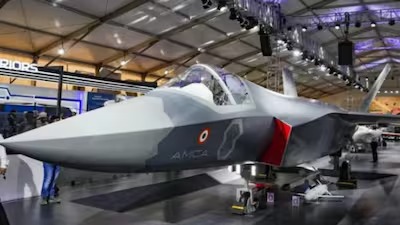
New Delhi: The United Kingdom has made a major technology transfer proposal to India for the engine that could power the Advanced Medium Combat Aircraft, offering complete technology transfer and full intellectual property rights as New Delhi evaluates competing bids for its future fifth generation fighter.
British aerospace giant Rolls Royce has proposed jointly developing an entirely new engine producing more than 120 kilonewtons of thrust specifically for the AMCA programme. The proposal is aimed at giving India greater control over the technology and the ability to develop future aero engines independently.
India is currently assessing engine options from Rolls Royce and France’s Safran for the more powerful version of the indigenous stealth fighter.
A key element of the Rolls Royce proposal is the promise of an engine without third party components. The approach is intended to reduce India’s dependence on external suppliers and minimise the potential impact of future sanctions or export restrictions.
The British offer also places emphasis on ownership of intellectual property, potentially allowing India to use and further develop the technology without remaining tied to foreign licensing arrangements.
The proposal comes as Rolls Royce expands its industrial presence in India through its partnership with Reliance Industries. The two companies are working towards establishing aerospace manufacturing capabilities in the country, including production of aero engine components.
A larger AMCA engine programme could provide another opportunity to expand Indian participation in the design, development and manufacturing of advanced propulsion systems.
The AMCA is India’s most ambitious fighter aircraft programme and is intended to deliver a domestically developed fifth generation stealth platform.
The initial AMCA Mk1 is planned to use the American GE F414 engine. However, the heavier and more advanced Mk2 variant is expected to require a substantially more powerful engine in the 110 to 130 kilonewton class.
The new powerplant will be critical for carrying heavier weapon loads while meeting the demanding performance and stealth requirements of the next generation aircraft.
If accepted, the Rolls Royce proposal could represent a major shift in India’s approach to fighter engine development by combining foreign expertise with domestic design capability and intellectual property ownership.