Team Goemkarponn
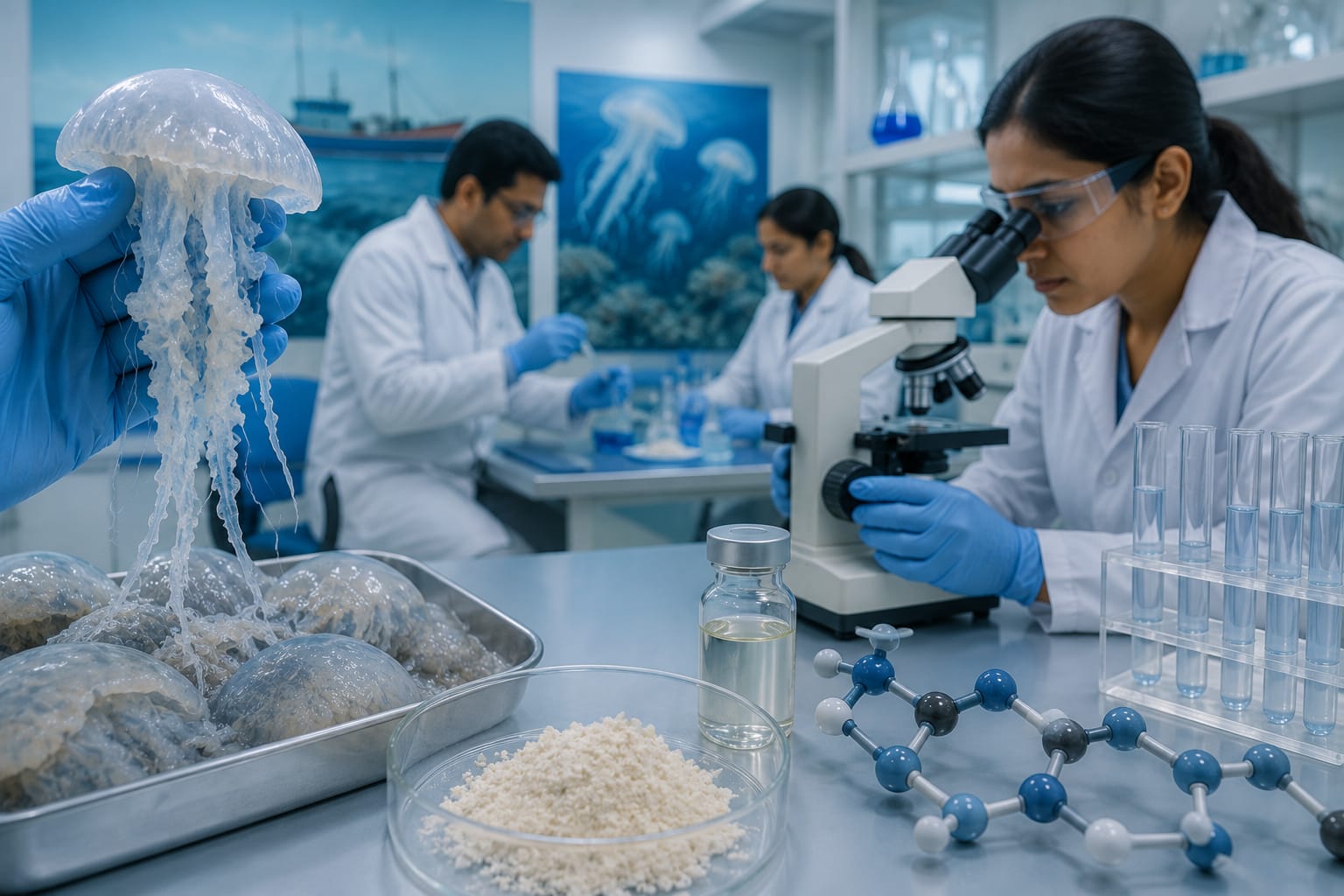
PANAJI: Scientists at the CSIR-National Institute of Oceanography (CSIR-NIO) in Goa have developed a patented technology that converts jellyfish into high-grade Type-II collagen, a development that could significantly reduce India’s dependence on imported marine collagen while creating fresh economic opportunities from an underutilised marine resource.
The institute said the newly developed process produces water-soluble Type-II collagen enriched with cysteine and other beneficial amino acids. Designed for use in sectors such as healthcare, cosmetics, nutraceuticals and biomedical research, the collagen is also free from the strong odour commonly associated with marine-derived products.
Researchers believe the innovation could transform jellyfish—often viewed as a low-value or nuisance marine species—into a commercially valuable raw material. The technology is expected to benefit coastal communities by creating an additional source of income through the collection and utilisation of jellyfish biomass.
To take the innovation from the laboratory to the marketplace, CSIR-NIO has invited Expressions of Interest (EOIs) from companies engaged in marine products, pharmaceuticals, cosmetics, nutraceuticals and other allied industries for technology transfer and commercial manufacturing.
The institute pointed out that India’s demand for marine collagen continues to rely heavily on imports, with collagen peptides worth an estimated ₹150 crore to ₹300 crore being sourced from overseas each year. At the same time, the global marine collagen industry is forecast to witness strong growth over the next several years, creating significant opportunities for domestic manufacturers.
Unlike conventional Type-II collagen, which is largely extracted from chicken cartilage, the jellyfish-derived product provides an alternative marine source. According to the researchers, it contains 21 amino acids, including cysteine, methionine and tryptophan—nutritionally valuable compounds that are generally absent in commercially available Type-I collagen.
Laboratory evaluations have shown that the collagen possesses antioxidant properties and demonstrates potential in wound healing, skincare formulations, tissue engineering and the development of advanced biomaterials.
The institute also reported that the collagen contains naturally occurring minerals such as zinc, iron, calcium, copper, potassium and sulphur. Safety assessments further confirmed that the material is free from detectable levels of toxic heavy metals, including mercury, lead, arsenic, cadmium and chromium.
CSIR-NIO said the innovation represents an important step towards strengthening India’s marine bioeconomy by encouraging indigenous production of specialised collagen, reducing import dependence and establishing a sustainable value chain around the commercial utilisation of jellyfish resources.