Team Goemkarponn
PANAJI: Goa is expanding its renewable-energy strategy beyond rooftop solar, with the government planning a series of projects involving panchayats, agricultural land, educational institutions and waterways as it works towards adding 65 MW of solar capacity by 2027.
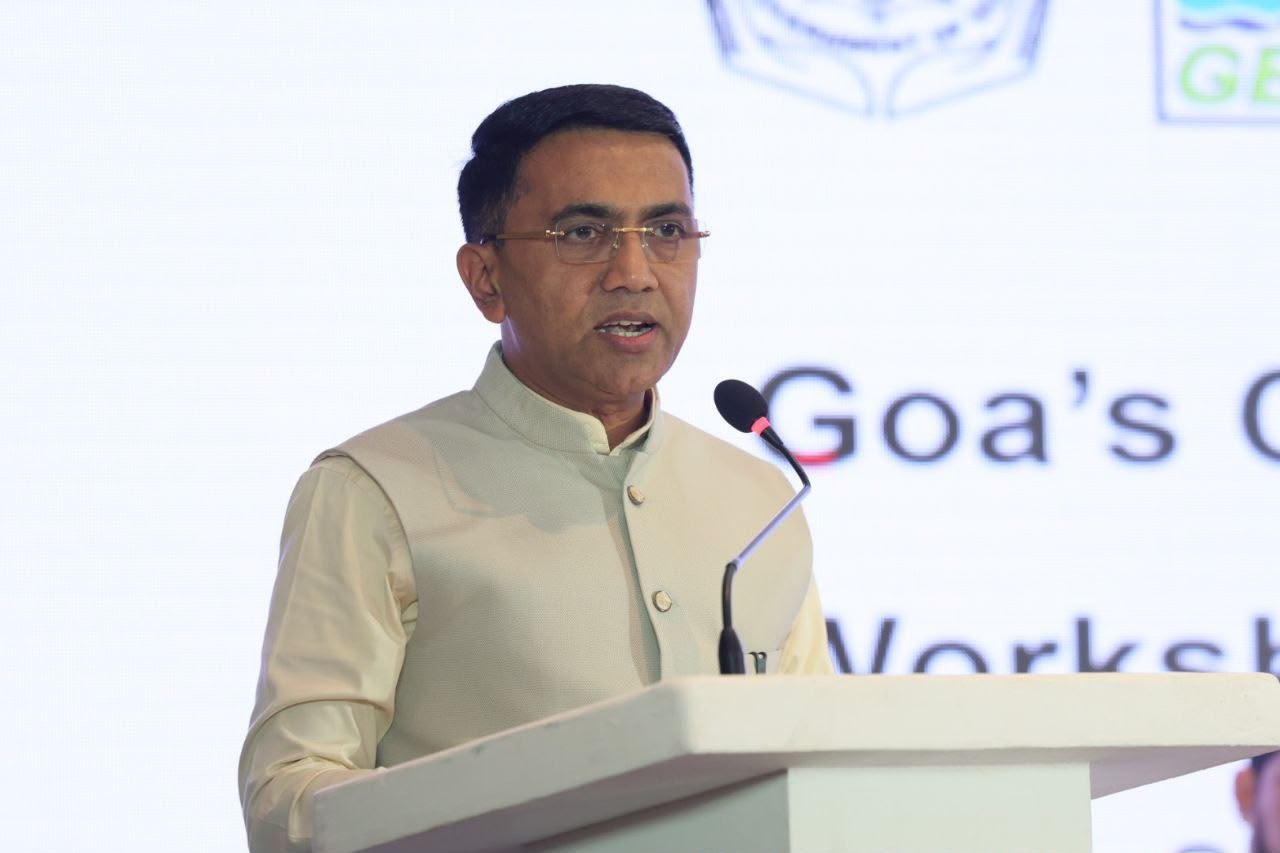
Chief Minister Pramod Sawant said that the State had set a target of 21,200 rooftop solar installations by 2027, but stressed that the clean-energy transition would require wider participation from local communities and public institutions.
The government is developing programmes that will allow panchayats to assess their energy use and carbon emissions and work towards becoming more energy-efficient. The Model Solar Village and Net Positive Panchayat initiatives are among the measures being introduced as part of this approach.
Goa is also testing whether renewable-energy projects can be integrated with existing economic activities. An Agri-PV pilot at the Goa Agriculture College will study the feasibility of generating solar power alongside agricultural production.
The State is further examining floating solar and canal-top installations, while buildings could be incorporated into the solar programme through photovoltaic systems integrated into their design.
Renewable energy is also being linked with household needs. Under a proposed Green Cooking with PM Surya Ghar pilot, rooftop solar will be explored as a source of power for cooking and water heating, potentially reducing conventional energy consumption in homes.
The government is extending the transition to the transport sector through the Goa E-boat programme, aimed at encouraging electric propulsion on inland waterways. Educational institutions will also be encouraged to participate through the Mission Net Zero Campus competition.
Sawant said Goa needed to develop practical projects that could eventually be adopted on a larger scale rather than limiting the clean-energy transition to isolated initiatives.
“Our focus must now be on implementation,” he said, urging local governments, communities, farmers, private companies, academic institutions and development organisations to participate.
The State has also entered into an MoU involving the Department of New and Renewable Energy, Goa Energy Development Agency, the German Embassy and technical partners for cooperation in technology, knowledge sharing and capacity building. A GIZ-supported programme to strengthen the skills of government officials was launched alongside the workshop.
In the residential sector, Goa is providing support for rooftop solar under the Mukhyamantri Muft Bijli Yojana and PM Surya Ghar. Sawant said 3,100 Goans had registered for solar units under PM Surya Ghar by February 2026, with 289 homes already using rooftop systems. More than 4,700 feasibility approvals had been issued and Rs 4.28 crore released in subsidies.
The government has set a broader ambition of eventually taking rooftop solar to half of Goa’s homes, with panchayat-level registration drives planned to increase adoption.