Team Goemkarponn
MARGAO: Chief Minister Dr Pramod Sawant said the state government is fully confident about the legality of the Mhaje Ghar housing scheme, stating that it was formulated only after a detailed legal review.
Reacting to questions on a recent Supreme Court ruling relating to tenancy and land ownership, Sawant said he had not yet gone through the judgment in detail and would study its legal implications before offering a detailed comment.
He clarified that the government had carried out the necessary legal examination before introducing the Mhaje Ghar scheme and remains confident about its validity. Referring to petitions pending before the High Court, the Chief Minister said the state is contesting the cases and believes there is no legal obstacle to the implementation of the scheme.
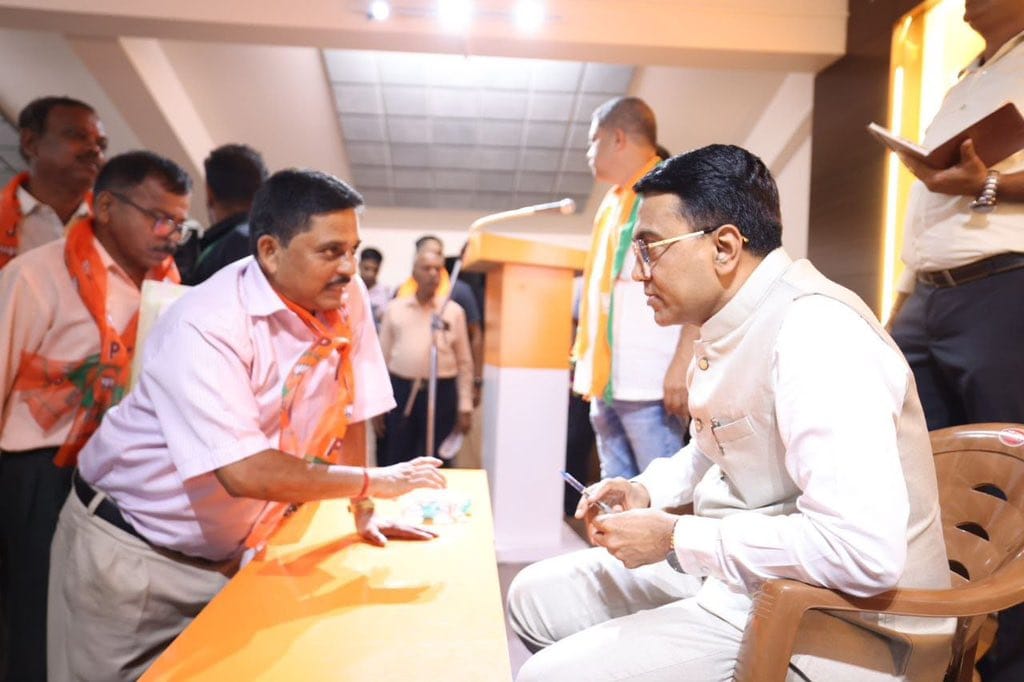
Sawant was speaking after conducting a public grievance meeting at the BJP South Goa district office, where residents and party workers from South Goa and Kushavati districts raised a range of civic and administrative issues.
He said a large number of complaints received during the interaction were related to housing matters, particularly those connected with the Mhaje Ghar scheme. Directions have been issued to officials, including the Collector and Mamlatdars, to examine the cases and take appropriate action wherever required.
The programme was attended by PWD Minister Digambar Kamat, BJP Goa President Damu Naik, BJP legislators Nilesh Cabral and Ulhas Tuenkar, as well as South Goa Zilla Panchayat Chairperson Sidharth Gauns Desai.
When asked about the ongoing protest by Karapur residents at Jantar Mantar in New Delhi, Sawant said the issue is presently before the village panchayat and the courts. He added that the panchayat would deal with matters falling under its jurisdiction, while the legal process would take its own course.
The Chief Minister also revealed that the government is preparing a policy for the rehabilitation of slum dwellers. He observed that only a handful of slum settlements in Goa have been officially notified under the Slums Act, making a separate rehabilitation framework necessary to address the needs of such communities.