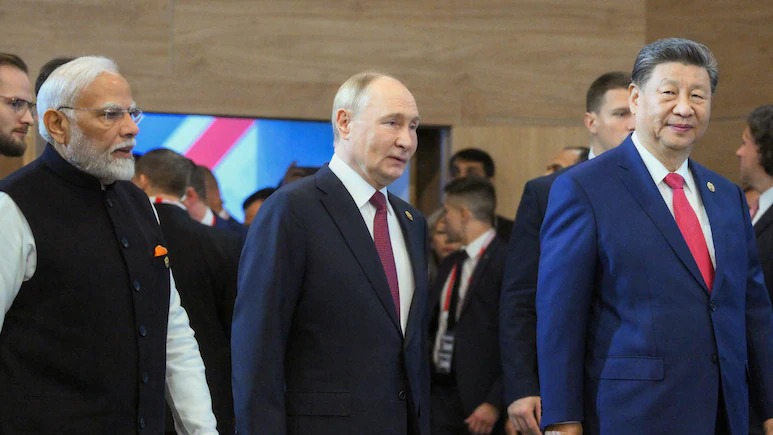
New Delhi: Russian President Vladimir Putin, Chinese President Xi Jinping and Iranian President Masoud Pezeshkian are among the prominent leaders expected to attend the BRICS Summit in New Delhi on September 12 and 13.
India is hosting the summit after a five year gap, bringing together leaders from an expanded BRICS grouping that now spans Asia, Africa, the Middle East and Latin America. South African President Cyril Ramaphosa, Egyptian President Abdel Fattah el Sisi, Belarusian President Alexander Lukashenko, Kazakh President Kassym Jomart Tokayev and Indonesian President Prabowo Subianto are also expected to attend.
Malaysia’s Prime Minister Anwar Ibrahim, Thailand’s Prime Minister Anutin Charnvirakul and Ethiopian Prime Minister Abiy Ahmed are likely to join the gathering. Cuba, Nigeria and Uzbekistan are expected to be represented by their presidents, Miguel Diaz Canel, Bola Tinubu and Shavkat Mirziyoyev.
Brazilian President Luiz Inacio Lula da Silva is not expected to attend because of domestic commitments, with Foreign Minister Mauro Vieira likely to represent the country. Uganda, Vietnam and the United Arab Emirates are also expected to send senior representatives instead of their heads of state.
Trade, development financing and reforms to global institutions are expected to remain central to the official agenda. However, the continuing conflict in West Asia and tensions involving Iran and the UAE could become major points of discussion behind closed doors.
Iran is expected to seek language in the summit declaration reflecting its position on the conflict, strikes and sanctions. Reaching consensus could prove challenging because BRICS decisions require agreement among members.
Xi’s expected visit would carry particular significance for India China relations, following years of tensions along the Line of Actual Control. Putin’s presence could also provide an opportunity for discussions with Prime Minister Narendra Modi on trade, energy and defence cooperation.
India continues to maintain close strategic ties with Russia while simultaneously working to stabilise relations with China, making the Delhi summit an important test of New Delhi’s diplomatic balancing.