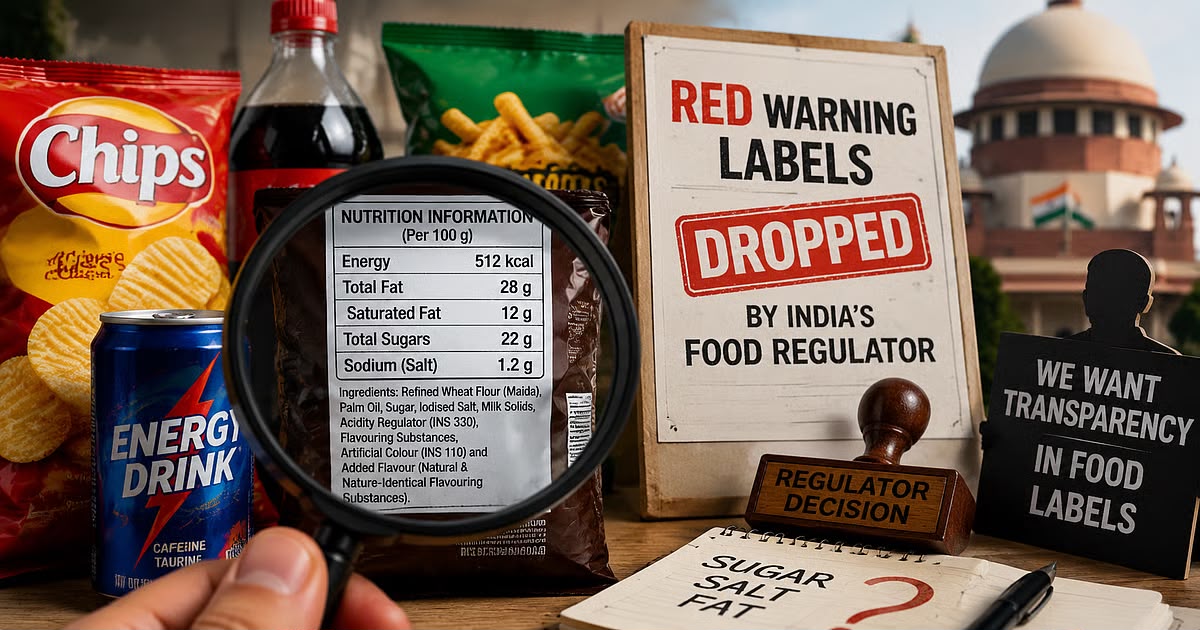
New Delhi: India’s effort to introduce clearer warning labels on packaged foods high in sugar, salt and fat has run into strong resistance from major food and beverage companies, raising questions about how consumers are informed about the health risks of everyday products.
The country’s food safety regulator had considered introducing prominent front of pack warnings that would make it easier for consumers to identify products containing excessive levels of sugar, salt and fat. However, following discussions with industry representatives, the regulator moved away from the proposed colour coded system and instead backed a simpler black and white nutritional information table.
Health experts and activists have challenged the decision, arguing that consumers need information that is immediately visible rather than being required to examine detailed nutritional tables on the back of packages.
The debate has gained importance as India faces a growing burden of obesity and lifestyle related illnesses. A recent study estimated that hundreds of millions of Indians could be overweight or obese by 2050.
Industry groups have argued that colour coded warnings could oversimplify nutritional information and create confusion. They have also raised concerns that products containing naturally occurring sugar could receive the same warning as products with added sugar.
India has considered stronger front of pack labelling since 2017, including warning symbols and nutritional ratings. However, manufacturers currently remain primarily responsible for providing ingredient and nutritional information on the rear of packages.
The controversy has also highlighted differences between products sold in India and overseas markets. Several multinational companies use interpretive nutritional labels in European markets while similar products in India generally carry less prominent information.
Consumer campaigns have increasingly drawn attention to differences in ingredients, sugar levels, oils and other formulations across countries. Social media influencers have played a growing role in pushing companies and regulators to address these concerns.
At the same time, changing consumer preferences are encouraging some manufacturers to introduce healthier alternatives. Companies have expanded sugar free and reformulated products as health awareness rises.
The ongoing debate ultimately centres on how much information consumers should receive before purchasing packaged food. With obesity and diet related health concerns increasing, pressure is growing on regulators to create a labelling system that is clear, transparent and effective.