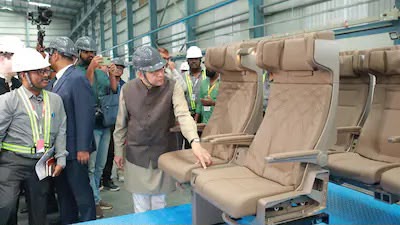
New Delhi: India is preparing to introduce its first indigenously designed high-speed bullet train, marking a major milestone in the country’s railway manufacturing capabilities. The eight-coach train is being manufactured at the Bharat Earth Movers Limited (BEML) facility in Bengaluru for the Mumbai-Ahmedabad High-Speed Rail corridor.
Designed by Indian engineers to suit the country’s climatic and operational conditions, the train will have a maximum test speed of 280 kmph and an operational speed of 249 kmph.
The 202-metre-long train will accommodate 557 passengers and comprise four motor cars and four trailer cars. Its configuration will include seven standard-class coaches with 3×2 seating and one executive-class coach with 2×2 seating. Two dedicated seats will be available for persons with reduced mobility.
The train will feature driver’s cabins at both ends, equipped with an intelligent onboard control system to support communication and coordination with the operation control centre. Two eight-coach trains can also be coupled to operate as a 16-coach formation when required.
Passenger Comfort and Modern Facilities
The interiors have been designed to provide greater comfort, with spacious seating, generous legroom and wide windows offering scenic views. A sealed gangway connecting the coaches will allow passengers to move between compartments conveniently.
Other facilities will include LED lighting, overhead luggage racks, dedicated storage for oversized baggage and individual power outlets for charging electronic devices.
Modern bio-digester toilets will also be installed to minimise environmental impact. A dual-unit heating, ventilation and air-conditioning system in every coach will maintain comfortable temperature and humidity throughout the journey.
Advanced Information and Accessibility Features
Passengers will have access to LCD information displays providing updates in English, Hindi and regional languages. Automatic announcements, public address systems and Wi-Fi-based infotainment facilities will further improve the travel experience.
Emergency communication units will be installed inside passenger compartments and vestibules to allow travellers to contact train crew members when required.
The train will also feature level boarding, retractable footsteps, accessible toilets and Braille-enabled signage to assist passengers with reduced mobility and visual impairments.
Energy Efficiency and Safety Technology
Powered by a 25 kV AC overhead electrical system, the train will use regenerative braking technology to recover energy during deceleration and feed it back into the electrical grid.
Its aerodynamic design has been developed using advanced computer simulations to reduce air resistance, turbulence and noise, particularly while passing through tunnels. Additional sound insulation and noise-damping materials will help provide a quieter journey.
With its combination of indigenous manufacturing, modern technology and passenger-focused facilities, the train represents an important step in India’s ambition to establish a high-speed rail network.