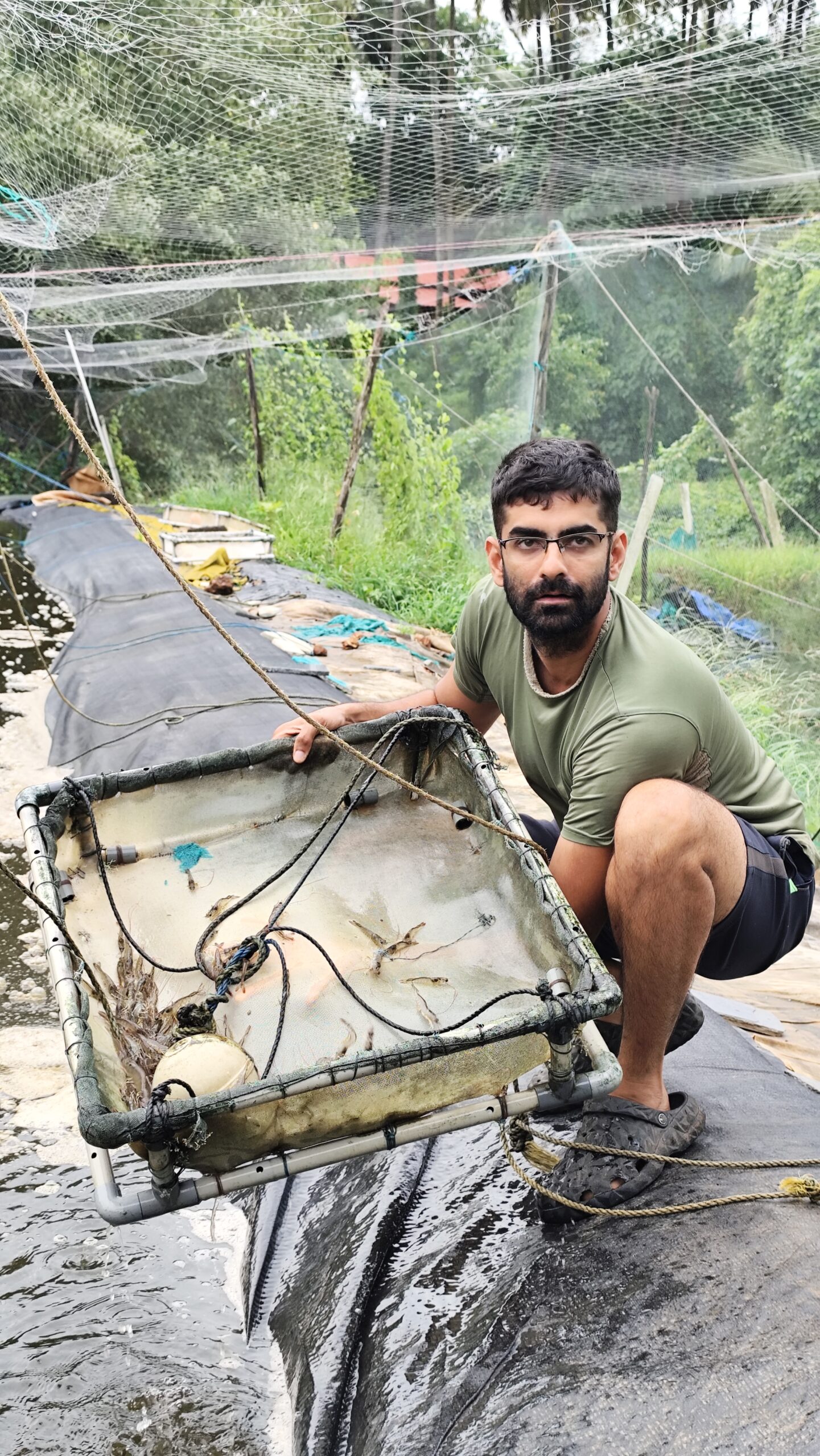
MADKAI, GOA — In the quiet village of Madkai in Ponda taluka, a second-generation aqua farmer is quietly rewriting the rules of coastal aquaculture. Meet Shaurya Shandillya, the young owner of Agro National Farms, who is combining traditional wisdom with cutting-edge technology to produce premium Vannamei shrimp—all while running his entire operation on solar energy.
At Agro National Farms, the journey of a shrimp is nothing short of a scientific marvel. The cycle begins with post-larvae, each weighing a mere 0.02 grams—about the size of half a grain of basmati rice. Over a 120-day (4-month) rearing period, these tiny creatures grow into market-ready prawns, meticulously cared for under Shaurya’s watchful eye.
Currently, the farm boasts over 70,000 shrimp thriving in a 200-square-meter licensed facility, operating under the strict guidelines of India’s Coastal Aquaculture Authority. “We maintain rigorous water chemistry—pH, alkalinity, mineral content, and plankton levels are monitored daily,” explains Shaurya. “The foam you see on the water’s surface? That’s plankton, their natural food.” The shrimp are fed a diet of biofloc (brown algae) four times a day—at 6 am, 10:30 am, 2 pm, and 6 pm—with quantities meticulously calculated based on their body weight and developmental stage.
What sets Agro National Farms apart is its commitment to sustainability. All pumps and equipment run 24 hours on solar energy, significantly reducing the farm’s carbon footprint. Water quality is paramount: 20-30% of the water is exchanged daily to introduce fresh minerals, while the ideal temperature is maintained between 28-32 degrees Celsius. “If the temperature fluctuates beyond this range, feed consumption drops and the shrimp weaken,” Shaurya notes. “During continuous rains, we use pipes in the corners to drain out the lighter freshwater, as saltwater is heavier.”
The farm follows a unique natural rhythm: shrimp molt every 15 days, with full moons and new moons triggering the shedding of their old shells. Essential minerals like Calcium, Potassium, and Magnesium are maintained according to strict norms to support this process. Probiotics are added to the feed for gut health, and a separate reservoir pond houses fish like mullets and other species that consume harmful pathogens while promoting beneficial bacteria.
Shaurya’s expertise extends to disease management. “If there’s an outbreak, feeding stops immediately. Shrimp start swimming on the surface, and dead bodies begin floating—these are clear signs of mortality,” he says. “But if we follow central government guidelines, there’s nothing to worry about.” To keep pathogens at bay, the water is chlorinated, and the farm is protected with bird and crab fencing.
Harvesting takes place in three ways: dry pond handpicking, drag netting, and cast netting. Export companies arrive with icing cars, freezing the catch at -20 degrees Celsius for export or local consumption. Some shrimp are also sold as live bait at 90 days old. With the current batch expected to yield 1.7 to 2 tonnes, prices range from ₹320 to ₹720 per kilogram—higher rates for larger shrimp with fewer pieces per kilo.
Daily records are maintained for temperature, pH, minerals, and feed, while turbidity meters (30cm to 20cm visibility) monitor plankton blooms. Salinity is checked regularly, and a separate tank holds larger prawns for premium sales.
As a family business now in its second generation, Agro National Farms stands as a testament to Goa’s growing potential in sustainable aquaculture. With Shaurya at the helm, the future of Goan shrimp farming looks brighter—and more scientific—than ever.