New Delhi: Canadian Prime Minister Mark Carney has said Canada is moving rapidly toward a free trade agreement with India, describing the proposed pact as a “game changer” for businesses and workers in both countries.
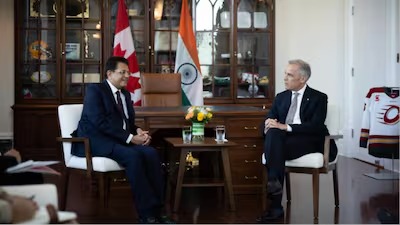
In a post on X, Carney said he recently met India’s Commerce and Industry Minister Piyush Goyal to review progress in the ongoing negotiations and explore opportunities in sectors including energy, agri-food, technology and education.
Goyal, who is currently visiting Canada with a large Indian business delegation, later said he conveyed greetings from Prime Minister Narendra Modi and discussed ways to deepen economic cooperation between the two countries. He expressed optimism over the early conclusion of the India-Canada Comprehensive Economic Partnership Agreement (CEPA), which has been under negotiation for several years.
The renewed momentum comes after a period of strained ties between India and Canada following the 2023 killing of Sikh activist Hardeep Singh Nijjar near Vancouver. Diplomatic relations had deteriorated after Canada alleged Indian involvement in the case, accusations strongly denied by New Delhi.
Both countries are now attempting to rebuild relations through economic engagement and strategic cooperation. Goyal described the partnership as being “reset very rapidly,” adding that Carney’s recent visit to India helped create a new framework for bilateral cooperation.
Officials from both sides are aiming to finalise the free trade agreement by the end of the year and increase bilateral trade to USD 50 billion by 2030. The discussions are expected to focus heavily on energy security, civil nuclear cooperation, clean technology, artificial intelligence and innovation partnerships.
The Indian delegation visiting Canada includes representatives from sectors such as mining, energy, pharmaceuticals, aerospace, agriculture, telecom and manufacturing, highlighting growing business interest in stronger economic ties.
Experts believe the renewed India-Canada partnership also reflects broader efforts by both countries to diversify trade relationships and reduce dependence on traditional markets amid shifting global economic conditions.