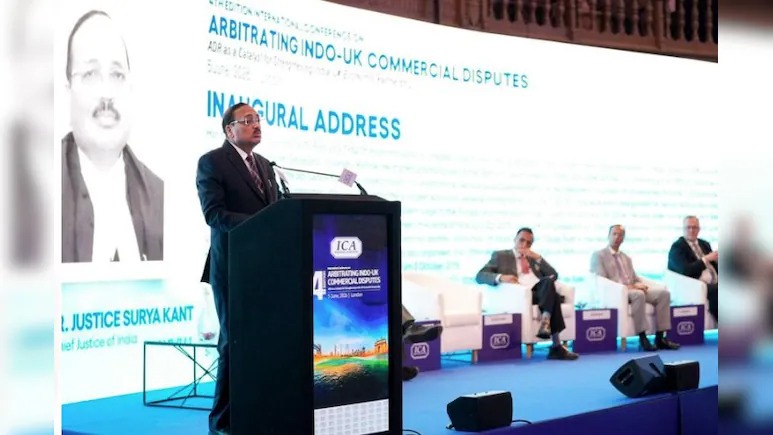
New Delhi: The Indian High Commission in London has strongly condemned the disruption of a public lecture delivered by Chief Justice of India Surya Kant at a London academic institution, describing the conduct of some audience members as inappropriate and inconsistent with respectful public discourse.
In an official statement, the High Commission said that while differing viewpoints are a natural part of democratic engagement, they should be expressed in a civil and courteous manner. It termed the interruption during the event as unacceptable and lacking the decorum expected at such forums.
Justice Surya Kant was speaking at Birkbeck, University of London on June 4, where he delivered a lecture on the theme of artificial intelligence and international law. During the question and answer session that followed, some attendees attempted to raise issues unrelated to the subject of the lecture, including concerns about dissent in India and remarks previously made by the Chief Justice that had attracted public attention.
As audience members began posing these questions, event organisers intervened and stopped the discussion, stating that the issues being raised were outside the scope of the lecture. The moderator informed attendees that the session was intended to focus specifically on artificial intelligence and international law and therefore unrelated questions could not be entertained.
Videos from the event later circulated widely on social media, showing an audience member referring to India’s democratic record and expressing concerns about what she described as increasing hostility towards dissent. Before the question could be fully developed, the moderator ended the exchange and moved on.
In his address, Justice Surya Kant described artificial intelligence as a transformative force that is already influencing governance, commerce, warfare, communication, public administration, and judicial systems across the world. He stressed that rapid technological advancement must remain anchored to constitutional principles, democratic accountability, and respect for human dignity.
The Chief Justice also warned that decisions made during the current decade would significantly shape the future relationship between technology, power, freedom, and justice, making it one of the defining challenges facing international law in the years ahead.
Sorry, there was a YouTube error.