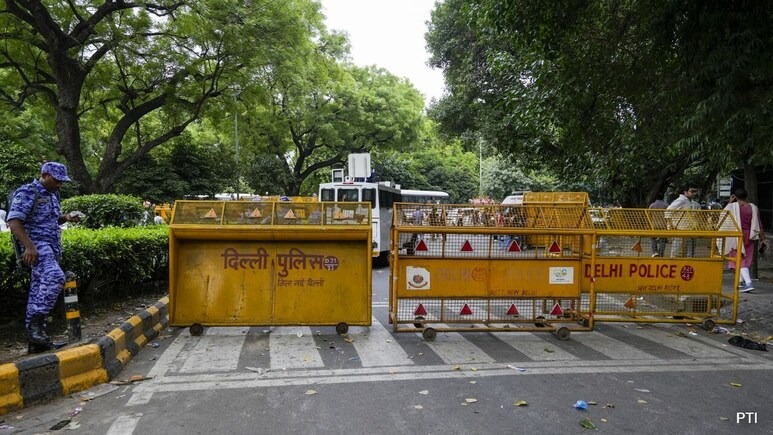
New Delhi: Heavy security and widespread restrictions were enforced across central Delhi on Monday as thousands of supporters of the Cockroach Janta Party (CJP) gathered for the proposed “Chalo Sansad” march on the opening day of the Monsoon Session of Parliament.
Ahead of the protest, Delhi Police imposed prohibitory orders under Section 163 of the Bharatiya Nagarik Suraksha Sanhita (BNSS), banning unauthorised assemblies across the New Delhi district. Authorities clarified that no permission had been granted for the march, stating that demonstrations involving five or more people were prohibited outside designated protest sites with prior approval.
Despite the restrictions, large numbers of protesters assembled at Jantar Mantar before attempting to march towards Parliament. Police intervened to stop the procession, using batons to disperse the crowd as clashes and chaos unfolded in parts of the city. Mobile internet services were also suspended in parts of Central Delhi as a precautionary measure.
The CJP urged its supporters to remain peaceful despite the police action, appealing to demonstrators to avoid violence even if they were stopped at various locations.
Security arrangements were significantly intensified around Parliament, Jantar Mantar, Central Vista, Parliament Street, Connaught Place and other key government installations. Multi layered barricades, extensive vehicle checks, CCTV surveillance, rapid response teams and paramilitary personnel were deployed to prevent any breach of security during the Parliament session.
The protest also caused major disruption to public transport. Five Delhi Metro stations, including Rajiv Chowk, Janpath, Patel Chowk, Central Secretariat and Seva Teerth, were temporarily closed on security grounds, leaving hundreds of commuters stranded and forcing many to take alternative routes.
The CJP launched the protest campaign over alleged irregularities in the NEET medical entrance examination and has been demanding education reforms along with the resignation of the Union Education Minister.
The demonstrations gained further attention after activist Sonam Wangchuk, who had been on an indefinite hunger strike since June 28, was shifted to Safdarjung Hospital following a deterioration in his health. From the hospital, Wangchuk reiterated that he would end his fast only if the government accepted responsibility for alleged failures in the education system or political leaders assured him that the issue would be raised in Parliament.
Sorry, there was a YouTube error.