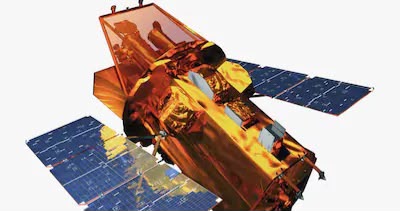
New Delhi: A retired NASA space telescope weighing approximately 1.5 tonnes is expected to plunge back into Earth’s atmosphere on November 4, raising questions about the possibility of debris reaching the ground. Mumbai, Hyderabad, Bengaluru and Chennai are among the Indian cities located within the broad geographical zone identified for its potential re-entry.
The Neil Gehrels Swift Observatory, originally known as the Swift Gamma-Ray Burst Explorer, was launched on November 20, 2004. The spacecraft was initially designed for a two-year mission but continued operating for nearly 22 years, making significant contributions to space research.
According to NASA’s projections, the telescope was expected to re-enter the atmosphere at approximately 2 pm IST on November 4. However, the estimated timing carries an uncertainty window of around 11 hours.
Most of the spacecraft is expected to burn up due to the extreme heat generated during atmospheric re-entry. Nevertheless, certain stronger components could survive the process and reach Earth’s surface.
The projected re-entry zone extends between 20.6 degrees south and 20.6 degrees north latitude, covering parts of Africa, Australia, India, Southeast Asia and Central and South America.
In India, the broad geographical belt includes areas south of an imaginary line running approximately from Daman on the western coast to Cuttack in Odisha. Mumbai, Hyderabad, Bengaluru and Chennai fall within this region, while Delhi, Kolkata and much of northern India remain outside it.
However, being within this latitude range does not mean these cities are directly threatened. The actual landing location will depend on the spacecraft’s position when it enters the atmosphere.
Experts believe most of the debris will probably fall into the ocean, as water covers approximately 70 per cent of Earth’s surface. They have also assessed the chances of debris causing injuries or damaging infrastructure as extremely low.
India has the Multi-Object Tracking Radar at Sriharikota, which can monitor satellites and rocket bodies approaching atmospheric re-entry. However, no confirmation has emerged regarding whether the descending telescope is being tracked.
Despite unsuccessful efforts to save the spacecraft, its scientific legacy remains significant. During its mission, Swift detected more than 2,000 gamma-ray bursts and observed approximately 1,400 supernovae, making it an important contributor to astronomical research.