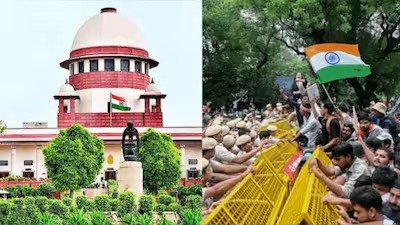
New Delhi: The Supreme Court on Monday reaffirmed that peaceful and lawful protests are protected under the Constitution, observing that police cannot resort to a lathi charge merely because people are demonstrating. The court said any allegations of excessive force by law enforcement must be independently examined and called for uniform protocols to regulate police action during public protests across the country.
The observations came while hearing a batch of petitions alleging police excess during the Cockroach Janata Party’s march in Delhi over the NEET paper leak controversy. The matter was heard by a bench comprising Chief Justice of India Surya Kant, Justice Joymalya Bagchi and Justice V Mohana.
During the hearing, the bench stressed that democratic societies must safeguard the right to peaceful protest while ensuring discipline and public order. The judges observed that the presence of a protest alone cannot justify the use of force and said complaints of police excess should be examined through an independent process.
The court also permitted a lawyer representing the families of injured police personnel to participate in the proceedings. Justice Joymalya Bagchi noted that injuries suffered by both protesters and police officers deserve equal attention and suggested that states may be asked to explain why adequate protective equipment, including helmets, is not routinely provided to personnel deployed for crowd control.
The petitions include claims from students alleging they were assaulted during the protests. One plea also alleges that AK 47 rifles were used against protesters in Bihar’s Siwan district. The petitioners have further sought comprehensive guidelines governing police action during demonstrations, including restrictions on the use of plainclothes personnel for crowd control, standard operating procedures for imposing prohibitory orders under Section 163 of the Bharatiya Nagarik Suraksha Sanhita, and safeguards against the misuse of Section 152 of the Bharatiya Nyaya Sanhita.
The protests at Delhi’s Jantar Mantar were led by the Cockroach Janata Party, which demanded greater transparency in public examinations, accountability for paper leaks and sweeping reforms to the examination system. The agitation also sought the resignation of then Union Education Minister Dharmendra Pradhan, who later stepped down after a 36 day protest campaign.
The demonstrations culminated in a large ‘Sansad Chalo’ march towards Parliament that witnessed clashes between protesters and police, tear gas shelling, detentions and allegations of excessive force from both sides. The agitation ended after the Centre accepted several key demands, including compensation for families of students who allegedly died by suicide following the NEET paper leak controversy and the withdrawal of FIRs filed against protesters.
The case remains under consideration, with the Supreme Court expected to further examine the need for nationwide policing standards that balance the constitutional right to protest with the responsibility to maintain public order.