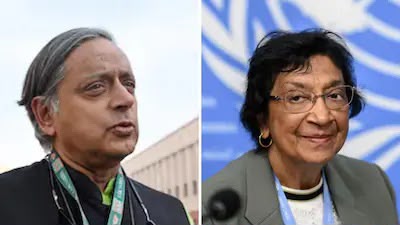
NEW DELHI: Congress MP Shashi Tharoor has criticised the Centre over what he described as the government’s failure to congratulate South African jurist Navanethem “Navi” Pillay on winning the 2026 Nobel Peace Prize, calling the alleged silence a “deplorable decision”.
In a post on X, Tharoor questioned why India had not acknowledged Pillay’s achievement despite her ancestral links to the country. He expressed disappointment that six days had passed since the announcement without a congratulatory message from the government.
Pillay’s ancestors originated from Tamil Nadu before migrating to Sri Lanka and subsequently South Africa more than 130 years ago. Her Nobel recognition has drawn attention to her family’s roots, with relatives in Dindigul district celebrating the achievement.
However, Tharoor’s criticism also triggered a backlash on social media. Some users questioned whether the Congress party itself had publicly congratulated Pillay, accusing the MP of applying different standards to the government and his own party. Others used the controversy to criticise Tharoor personally.
The Congress MP’s post included an AI generated video highlighting Pillay’s journey from a childhood marked by poverty and racial discrimination to becoming one of the most prominent figures in international law.
Born in Durban in 1941, Pillay pursued legal studies at the University of Natal before earning a doctorate from Harvard Law School in 1988. During South Africa’s apartheid era, she defended political prisoners and challenged racial discrimination within the legal system.
In 1995, she became the first non-white woman appointed to South Africa’s High Court. She later served at the International Criminal Tribunal for Rwanda and as the United Nations High Commissioner for Human Rights.
Pillay also played a significant role in the landmark 1998 Akayesu judgment, which recognised that rape and sexual violence could constitute acts of genocide under specific circumstances.
The Nobel Peace Prize was awarded in recognition of her contributions to peace and international law, bringing renewed attention to her decades of work defending human rights and promoting justice.