Panaji: The Directorate of Museums, Goa, organised a one-day state symposium on “Role of Museums in Conserving Heritage and History of Goa” at the Auditorium of Goa Science Centre and Planetarium, Miramar. The symposium brought together scholars, historians, curators and research scholars to discuss ways to preserve, document and interpret Goa’s rich cultural and historical legacy.
Proceedings began with the traditional lighting of the lamp, followed by the welcome address and inaugural remarks highlighting the role of museums in preserving Goa’s history and making its heritage accessible to present and future generations. The academic programme brought together diverse perspectives on conservation, documentation, cultural memory, education, community participation and identity.
Speaking on the occasion, Dr. Kishore Raghubans, Assistant Superintendent Archaeologist, Archaeological Survey of India, said Goa’s history should be viewed as a continuous journey shaped by different dynasties, cultures, religions and civilisations, rather than only through the arrival of the Europeans. “From the Mauryas, Satavahanas, Chalukyas and Kadambas to the Vijayanagara, Bahmani, Adil Shahi and Portuguese periods, every phase has left valuable evidence of Goa’s historical and cultural evolution,” he said.
Dr. Raghubans further emphasised that Goa’s heritage needs to be understood in its wider Indian and global context. He said the state’s temples, churches, mosques, paintings, manuscripts and archaeological remains reflect centuries of interaction between people, ideas and cultures. “It is our responsibility to study these historical layers, preserve the evidence and pass this knowledge to future generations, so that Goa is understood not merely as a destination, but as a place where centuries of history and diverse cultures meet,” he said.
Technical sessions covered manuscript conservation in tropical climates, monitoring environmental controls in museums, and a 3D digital heritage documentation framework for Goa Museum. Research presentations also focused on Goa’s historical avifaunal ecology and iconographic studies of Padmanabha and Virabhadra. Other presentations examined state collections as historical evidence, hero stones, commemorative artifacts, Goan pottery and local folk culture traditions, highlighting the importance of material and cultural collections in understanding Goa’s history.
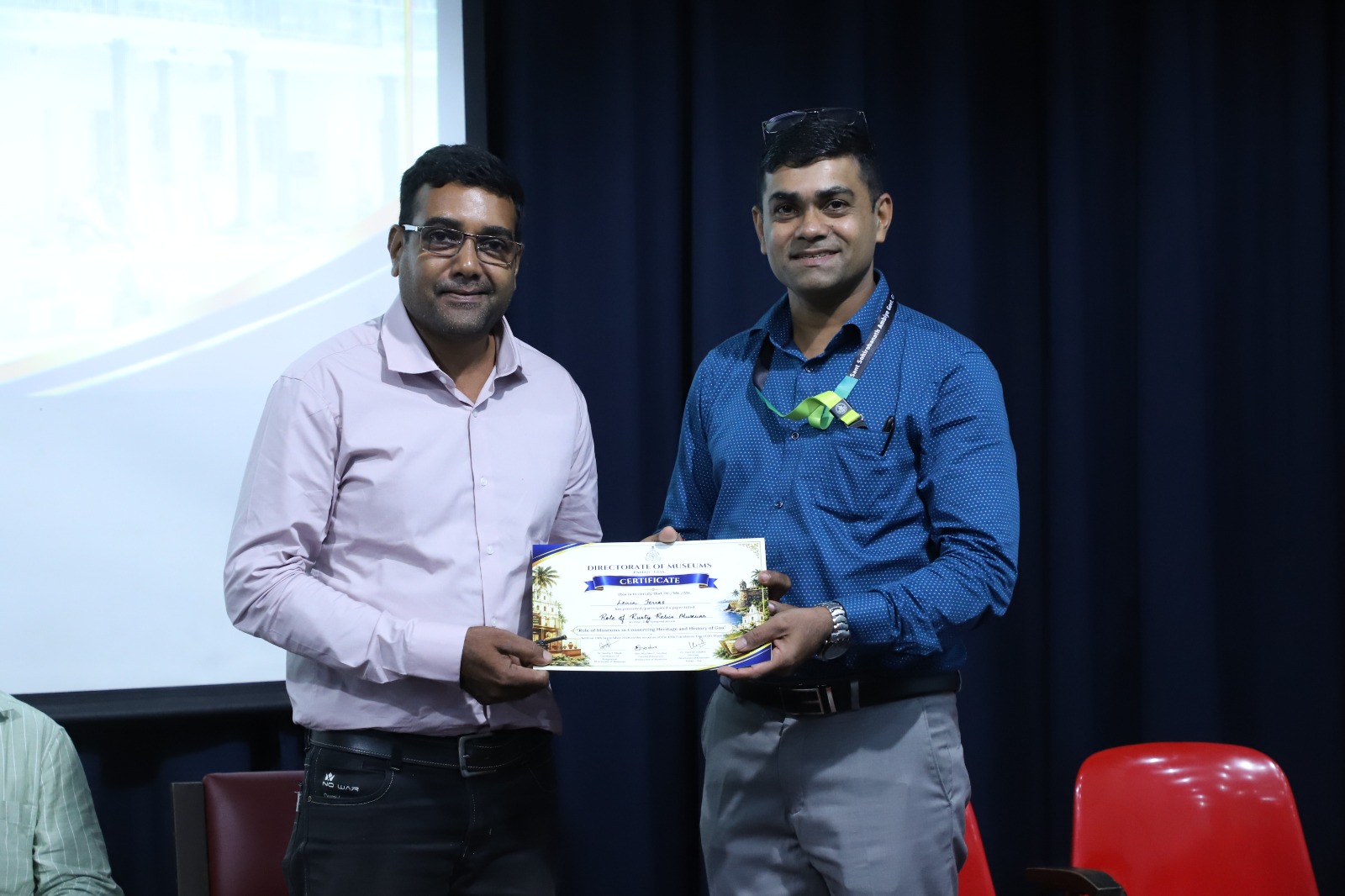
Further discussions explored museums as extensions of history classrooms under NEP 2020, Goa’s prehistoric past and present society, global trends in museology, Gawada women’s participation, heritage houses as museums and living museums. Deliberations also covered sculptural remains across Goa, including Chorao Island and Curpem. These discussions highlighted the need for stronger conservation, digital documentation, research and public engagement, while recognising community participation as an important part of preserving Goa’s heritage. The programme concluded with a valedictory session, where all paper presenters were felicitated with mementos and presented participation certificates.
The symposium was attended by Shri A.K. Bhelave, Centre Head, Goa Science Centre; Dr. Kishore Raghubans, Assistant Superintendent Archaeologist, Archaeological Survey of India, Goa Circle; and Dr. Sandeep Arjun Majik, Supervisor Coordinator of the symposium. The technical sessions were chaired by Dr. Arun Kumar Reddy Sama, Regional Director, IGNCA Regional Centre, Goa; Shri Prajal Sakhardande, Associate Professor, Dhempe College of Arts and Science; Smt. Natasha Fernandes, Curator, Museum of Christian Art, Old Goa; and Dr. Rita Braganza, Associate Professor, Rosary College of Commerce and Arts.