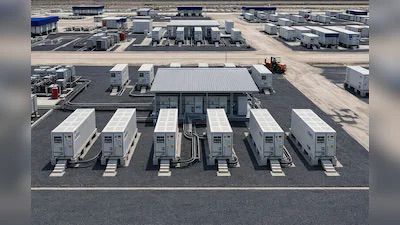
New Delhi: Adani Green Energy Ltd has commissioned a cumulative 3.37 gigawatt-hour Battery Energy Storage System at Khavda in Gujarat, making it the world’s largest battery storage deployment at a single location outside China. The project also ranks among the fastest utility-scale battery storage installations completed globally.
The latest expansion includes an additional 1.37 GWh capacity that became operational in March 2026, significantly increasing the company’s overall storage capability at the Khavda renewable energy site. The facility is expected to strengthen India’s clean energy infrastructure by improving grid stability and ensuring a more reliable supply of renewable power during peak demand hours.
The battery storage system has the capacity to store enough clean electricity to power nearly one million homes for an entire day. It can also support the peak electricity requirements of cities such as Indore and Chandigarh, or even meet the demand of the entire state of Goa. In addition, the stored energy could continuously power more than 12 million LED bulbs for up to 10 hours.
The project was completed within just 10 months from the start of on-site construction, highlighting the rapid pace of execution. The large-scale storage deployment is expected to play a crucial role in enabling round-the-clock green energy supply while helping renewable-heavy power grids remain stable and flexible.
Advanced lithium-ion battery technology and integrated energy management systems have been deployed to improve efficiency, responsiveness and operational reliability. The company views battery storage as a critical component in supporting India’s transition toward cleaner energy sources as renewable power generation capacity continues to expand rapidly.
The Khavda site is part of AGEL’s larger renewable energy development plan, where the company aims to build 30 GW capacity by 2029. So far, nearly 9.9 GW has already become operational. The company has also outlined plans to add more than 10 GWh of battery storage capacity in FY27 and expand this further to 50 GWh over the next five years.