Team Goemkarponn
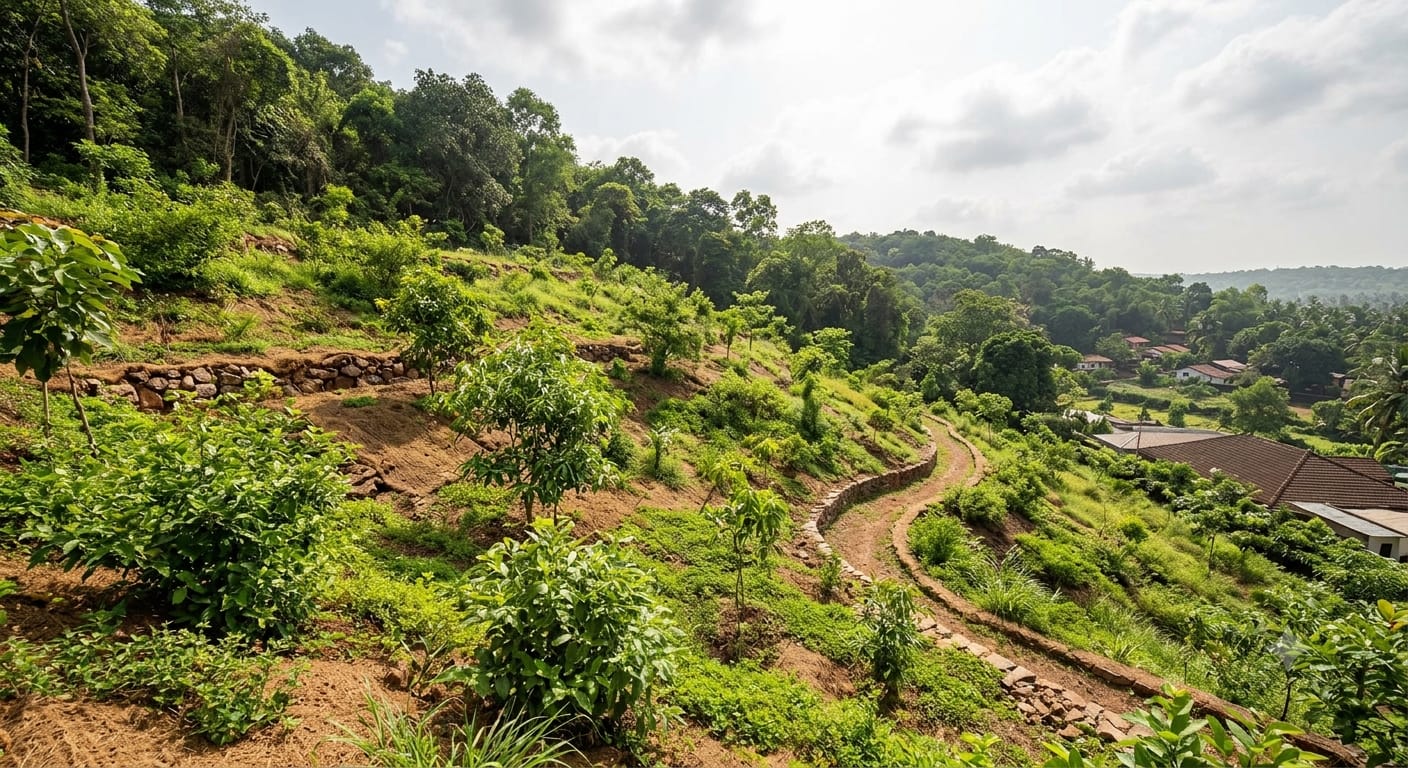
PANAJI: The four-year legal battle over the illegal cutting of a hill at Arpora has ended with the Bombay High Court at Goa recording that the hill has been restored to a stable condition.
The case, P.I.L. W.P. No. 20/2022 — Goa Foundation v. Village Panchayat of Arpora-Nagoa & Ors. — began after the Goa Foundation received a citizen complaint regarding hill-cutting and development activity behind the Park Regis Hotel at Arpora.
The Foundation first approached the Village Panchayat on March 31, 2022, after observing heavy machinery being used to cut the hill. It pointed out that the land was identified in the Regional Plan as a No Development Slope. However, the Panchayat declined to stop the work, stating that the complaint did not identify the person responsible.
With the hill-cutting continuing, the Foundation approached the High Court on April 12, 2022. The following day, the Court directed the Flying Squad to immediately stop the activity.
A subsequent inspection by the North Goa Planning and Development Authority (NGPDA) revealed extensive damage. The hill had been cut vertically by around 4–5 metres over a stretch of approximately 100 metres and horizontally by about 30 metres. Excavation had also been undertaken for a road around six metres wide, involving additional cuts of 2–3 metres.
Authorities later found that the hill-cutting had been carried out without the permission required under Section 17-A of the Goa Town and Country Planning Act, 1974.
The High Court also criticised the authorities for failing to act on their own. In its September 6, 2022 order, the Court described the NGPDA’s explanation for its earlier inaction as a “highly lame and insensitive plea”, observing that authorities responsible for preventing illegal hill-cutting could not wait for complaints before taking action. The Village Panchayat was also criticised for evading responsibility.
On September 20, 2022, the NGPDA held that the hill-cutting violated Section 17-A and directed restoration of the hill to its original condition. The following day, the Village Panchayat revoked the construction licence and issued a similar restoration direction.
The High Court admitted the petition on October 4, 2022, and directed that no fresh application for hill-cutting permission could be entertained until the site was restored. Further construction was also restrained.
Four years of monitoring to ensure genuine restoration
Obtaining the restoration order was only the beginning. The Goa Foundation continued monitoring the site over the following four years through repeated inspections and discussions with the Town Planning Department, technical experts and the private party.
In January 2024, the Court rejected an attempt to claim that the hill had already been restored, noting that the work had been carried out without the involvement or technical input of the Town Planning Department. The private party subsequently undertook to prepare a scientifically based restoration proposal.
The Foundation maintained that restoration had to be technically adequate and genuine rather than merely cosmetic.
In October 2025, the Town Planning Department engaged the Goa Engineering College (GEC) to scientifically determine how the hill should be restored. GEC submitted its recommendations in January 2026, following which the private party undertook further restoration in accordance with those recommendations.
In its report dated June 29, 2026, GEC found that the slope had been restored to a stable condition and that the restoration work complied with its technical recommendations.
When the matter came before the High Court on August 24, 2026, the Court recorded that the primary relief sought by the petition — restoration of the hill — had been achieved and disposed of the petition.
The Goa Foundation said the case highlights the importance of citizen vigilance and sustained environmental litigation. It said the hill was not restored because authorities acted promptly when the illegal cutting began, but because a citizen-led environmental organisation identified the damage, approached the authorities and then the Court when action was not taken, and remained involved until the restoration was independently verified as adequate.
The Foundation said the case should serve as a reminder that environmental laws cannot be effectively enforced if authorities wait for citizens to identify every violation. At the same time, it demonstrates that persistent citizen action can lead to the actual restoration of damaged natural resources rather than merely an order on paper.