Team Goemkarponn
PANAJI: Goa is treating less than half of the sewage it generates daily, with the State having an installed sewage treatment capacity of 87 million litres per day (MLD) against an estimated sewage generation of 176 MLD, according to information provided in the Rajya Sabha.
The figures indicate that Goa has treatment capacity for only around 47 per cent of its daily sewage generation, leaving a capacity shortfall of nearly 89 MLD.
The State’s sewage treatment infrastructure includes a 7.5 MLD plant at Colva, 15 MLD and 12.5 MLD plants at Panaji, a 2 MLD plant at Patto in Panaji, a 1 MLD plant at Durbhat, a 20 MLD plant at Vasco, and 20 MLD and 6.7 MLD plants at Margao. Goa also has a 15 MLD STP at Kavelem and a 0.8 MLD plant at Sanquelim.
With sewage generation nearly double the State’s installed treatment capacity, the government has moved to strengthen regulation of privately operated STPs in hotels, hospitals and residential complexes.
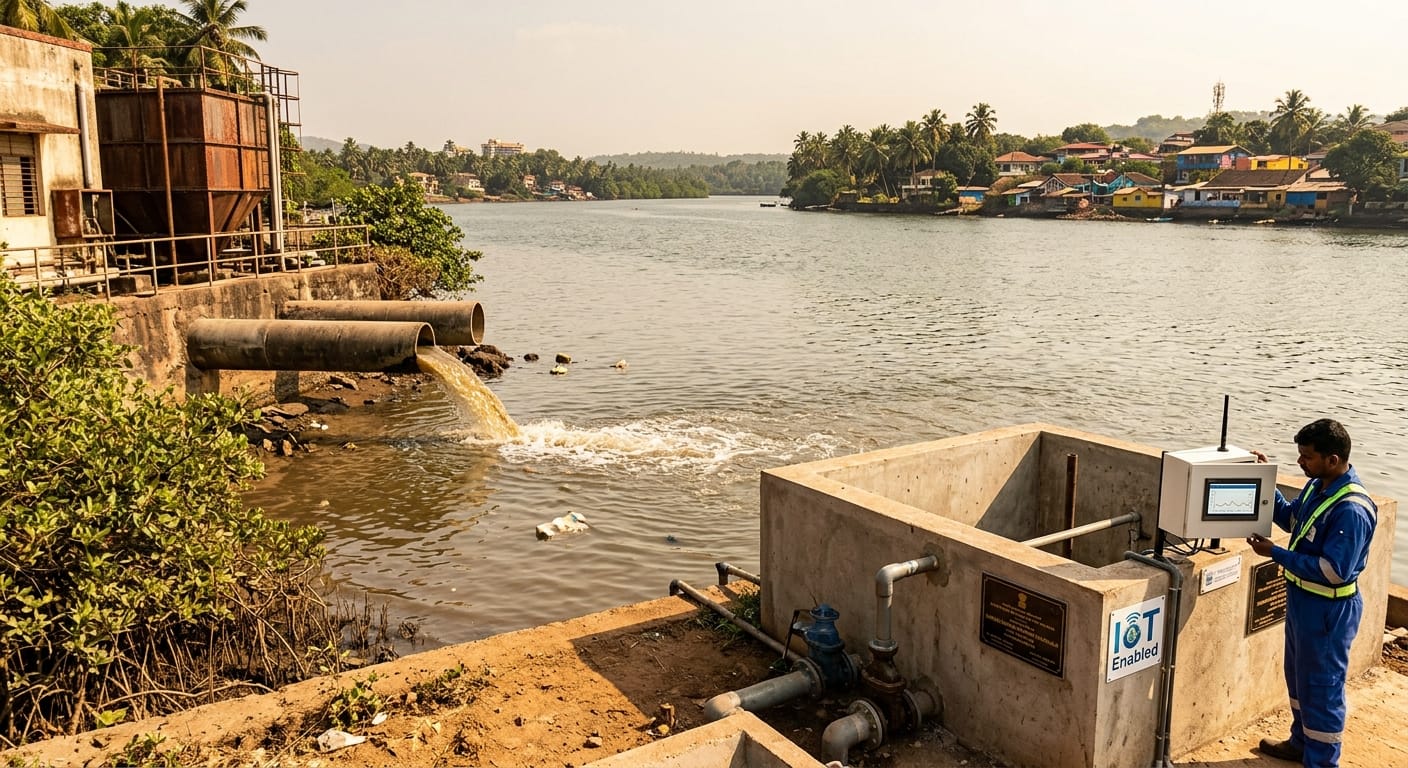
Under the new guidelines, such establishments have been mandated to install online Internet of Things (IoT)-based monitoring systems for their STP equipment within six months. The systems are aimed at enabling continuous monitoring of treatment plant operations and ensuring compliance with prescribed discharge standards.
Establishments found violating discharge standards for the first time will have their samples re-tested for confirmation. If the deviation is confirmed, a penalty of Rs 5,000 will be imposed, along with the cost of re-collection and analysis of samples.
For a second violation, the penalty will rise to Rs 20,000, while the Goa State Pollution Control Board will conduct a performance evaluation of the STP at the establishment’s expense.
Meanwhile, the Goa Sewerage and Infrastructure Development Corporation is adopting multiple technologies to expand sewage treatment and sewerage infrastructure. These include Sequential Batch Reactor (SBR), Membrane Bio Reactor (MBR), Natural Treatment System-Phytorid and Vacuum Sewerage Systems.
For laying and rehabilitating sewer lines, technologies such as Horizontal Directional Drilling (HDD), Micro Tunnelling (MT) and pipe bursting are also being used.