Team Goemkarponn
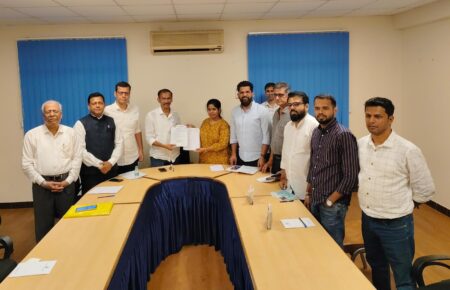
PORVORIM: The restrictions imposed on the newly opened elevated corridor in Porvorim have raised questions over whether the project will be able to deliver its intended road-safety benefits, with the North Goa District Road Safety Committee (NGDRC) pointing out that five existing black spots could remain unresolved.
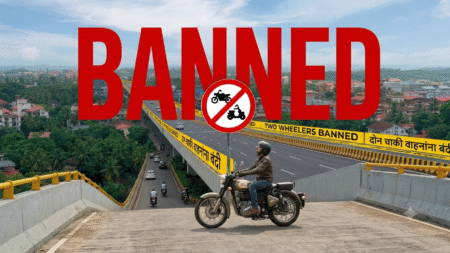
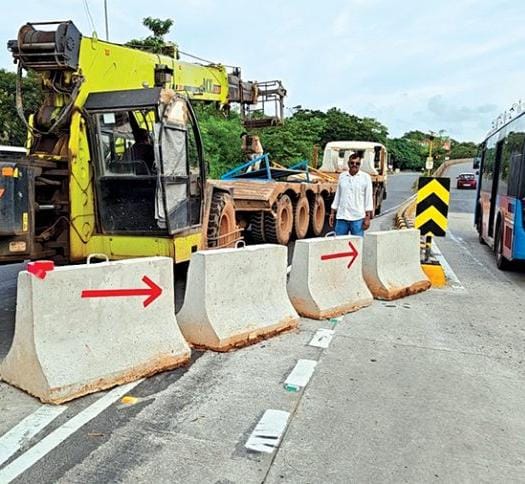
The elevated corridor was planned to improve traffic movement and address accident-prone stretches in Porvorim. However, a fatal accident reported within 24 hours of its opening prompted the Public Works Department (PWD) to stop two-wheelers from using the corridor and close access points towards the Atal Setu side.
The NGDRC said directing traffic back onto the service roads could undermine the purpose of addressing the identified black spots.
The committee stressed the need for motorists to receive advance information about the corridor and for adequate space to be provided at the Atal Setu entry point for safe merging.
It said information boards should be placed around one to two kilometres before the entry point. Adequate width should also be provided at the opening to allow vehicles to merge smoothly, in accordance with Indian Roads Congress (IRC) standards.
Following the fatal accident, two-wheelers have been directed to use the service roads below the elevated corridor. With the Atal Setu-side access points closed, motorists are being routed through the service-road network to enter Porvorim.
The road safety committee also questioned the decision to restrict two-wheelers, saying the focus should instead be on correcting safety arrangements rather than simply shifting traffic away from the elevated road.
It also cautioned against treating the elevated corridor as a stretch meant for high-speed driving.
The committee said it could have been consulted before the corridor was opened so that issues related to signage, merging and traffic management could have been addressed in advance.
Concerns were also raised over coordination between the PWD, traffic police and Transport Department, along with questions over the preparations made before the corridor was opened.
The NGDRC clarified that it was not consulted before the opening but does not have statutory powers to approve or stop such infrastructure projects.
The committee is an advisory body constituted following Supreme Court directions, and there is no specific requirement making prior consultation with it mandatory.