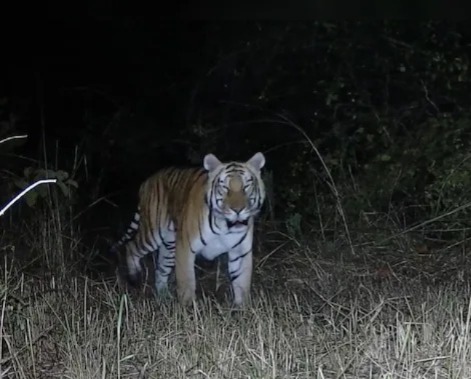
New Delhi: A Royal Bengal Tiger has been photographed inside D Ering Memorial Wildlife Sanctuary after nearly two decades, marking a major conservation milestone for Arunachal Pradesh.
The rare sighting was recorded through camera trap surveys carried out in the sanctuary with technical assistance from Ashoka Trust for Research in Ecology and the Environment.
Forest officials said the last confirmed evidence of a tiger in the sanctuary dated back to 2005, while only unverified sightings were reported between 2007 and 2008. A baseline survey conducted by World Wide Fund for Nature in 2014 had found no signs of tiger presence, attributing the disappearance largely to poaching and hunting activities in the region.
However, wildlife activity in the surrounding landscape had shown encouraging signs in recent months. Earlier this year, forest personnel in Assam’s Jonai forest range reported finding pugmarks believed to belong to an adult Royal Bengal Tiger near Kobu Chapori along the Assam Arunachal Pradesh border.
Divisional Forest Officer Kempi Ete described the development as a significant achievement and said the tiger’s return reflects the resilience of the ecosystem and the success of sustained conservation efforts. She credited frontline forest staff, Eco Development Committees, and local community organisations for helping protect the sanctuary and its habitat.
The recent wildlife survey also documented the presence of the critically endangered Chinese Pangolin and the endangered Hispid Hare, underlining the ecological importance of the sanctuary’s riparian grassland ecosystem. Officials noted that this habitat is unique among protected areas in Arunachal Pradesh.
Environmentalists have welcomed the tiger sighting, calling it positive news for biodiversity conservation as well as eco tourism in the region.
Located around 13 kilometres from Pasighat in East Siang district, D Ering Memorial Wildlife Sanctuary spans nearly 190 square kilometres and was established in 1978. Surrounded by the Siang and Sibya rivers, the sanctuary serves as an important habitat for tigers, leopards, wild buffaloes, and migratory birds.
Sorry, there was a YouTube error.