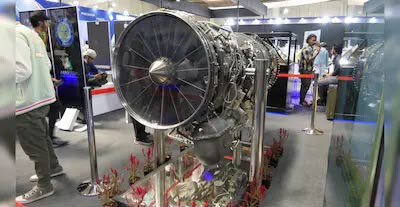
New Delhi: India’s indigenous Kaveri dry engine has successfully completed a series of high altitude and flight trials in Russia, achieving a peak dry thrust of 48.5 kilonewtons. The performance exceeds its original target of around 46 kN, marking an important step in the development of an Indian engine for future unmanned combat aircraft.
Developed by the Defence Research and Development Organisation’s Gas Turbine Research Establishment, the Kaveri Derivative Engine is a non afterburning version of the original Kaveri engine. It is being developed to power the Ghatak, India’s planned stealth Unmanned Combat Aerial Vehicle.
The latest trials were conducted at Russia’s Central Institute of Aviation Motors and the Gromov Flight Research Institute. At CIAM, the engine underwent high altitude simulations designed to replicate the low temperature and reduced air pressure experienced during flight at significant heights.
The engine was subsequently tested in the air using a modified Ilyushin Il 76 flying testbed. One of the aircraft’s existing engines was replaced with the Kaveri derivative, allowing engineers to evaluate its performance under actual flight conditions.
Testing covered different ambient pressures, Mach numbers and thrust requirements. The engine was assessed through both ground based and airborne trials before recording its maximum dry thrust of 48.5 kN.
With the Russian trials completed, the programme is now expected to move towards certification and integration in India. The test data will undergo evaluation by the Centre for Military Airworthiness and Certification before airworthiness clearance can be considered.
The successful trials do not yet mean the engine is ready for production or operational deployment. Certification and integration with the Ghatak platform will remain important steps.
Although the original Kaveri engine was not ultimately used on the Tejas fighter, the programme helped build Indian expertise in gas turbine technology. The latest derivative represents a continuation of that effort and could eventually support India’s growing range of indigenous unmanned aerial platforms.