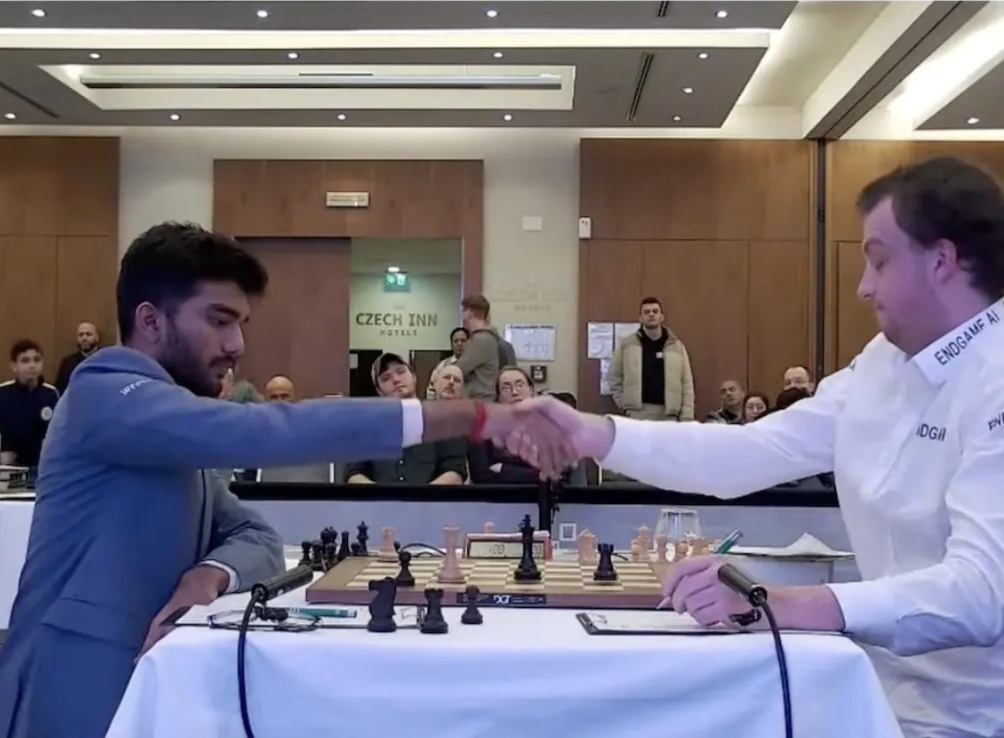
New Delhi: World champion D Gukesh opened his campaign at the Prague International Chess Festival by holding Hans Moke Niemann to a tense draw in the Masters section, surviving a challenging middle game in what proved to be the sole drawn contest of the opening round.
The game was shaped by a combative Berlin Defence that quickly set the tone. Despite playing with the white pieces, Gukesh was forced onto the defensive when Niemann opted for an ambitious approach, sacrificing a knight on the thirteenth move to generate initiative and long term pressure. The decision created a complex position that demanded precise calculation and calm defence from the Indian.
As the game progressed, Niemann built momentum with extra pawns as compensation for the sacrificed piece, pressing for an advantage and probing for weaknesses. Gukesh, however, remained composed under pressure. He neutralised threats at key moments, avoided tactical pitfalls, and gradually simplified the position without allowing the imbalance to turn decisive. With neither side able to force a breakthrough, the encounter eventually settled into a draw.
The remaining Masters games all produced clear results. Defending champion Aravindh Chithambaram was outplayed by Nodirbek Abdusattorov. Aravindh’s Philidor Defence initially held firm, but a precise manoeuvre from the Uzbek shifted the balance. The Indian went on to lose in a rook and minor piece endgame after conceding a vital pawn.
Top seed Vincent Keymer endured a difficult start, falling to a confident display from Jorden van Foreest. Another Berlin Defence featured, with Van Foreest introducing a fresh idea that left Keymer struggling. The Dutchman converted his advantage smoothly after collecting multiple pawns.
Elsewhere, Nodirbek Yakubboev defeated David Anton Guijarro, while home favourite David Navara overcame Parham Maghsoodloo.
In the Challengers section, Women’s World Cup winner Divya Deshmukh drew with top seed Benjamin Gledura after missing winning chances, while Surya Shekhar Ganguly was defeated by Thomas Beerdsen.
Sorry, there was a YouTube error.