Team Goemkarponn
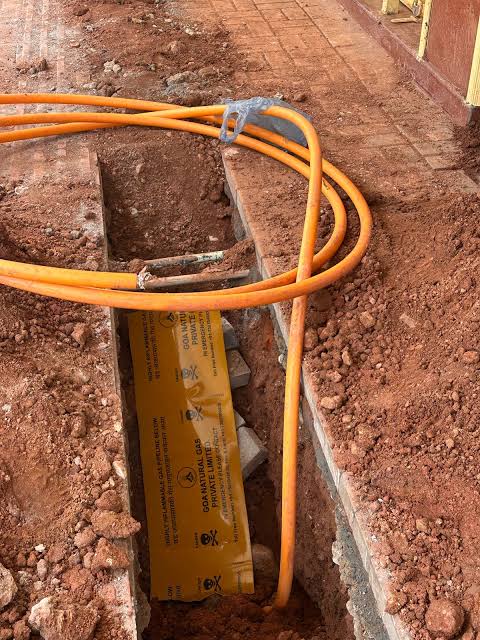
PANAJI: Seeking to remove procedural bottlenecks in the expansion of energy infrastructure, the Goa government has introduced a new framework that mandates time-bound approvals for natural gas and petroleum pipeline projects and provides for automatic clearance if authorities fail to act within the prescribed period.
The Directorate of Civil Supplies has notified the Natural Gas and Petroleum Products Distribution (Through Laying, Building, Operation and Expansion of Pipelines and Other Facilities) Order, 2026, establishing a uniform mechanism for granting permissions required for pipeline projects across the State. The order also lays down guidelines governing the grant of Right of Way (RoW) and Right of Use (RoU).
According to the government, the new regulations are intended to overcome delays arising from lengthy approval procedures, multiple permissions, high processing costs and difficulties in securing access to public and private land for infrastructure works. The order also highlights the need to expand the use of natural gas as a cleaner fuel while reducing dependence on LPG, particularly in the backdrop of recent uncertainties in global LNG supplies.
The notification makes it mandatory for government departments, local authorities, resident welfare associations, landowners and any other entities controlling access to land to extend the necessary cooperation for pipeline and related infrastructure projects undertaken by authorised agencies.
Public authorities have been directed to process requests for permissions required to lay, operate or expand underground and above-ground pipelines, along with associated infrastructure, within clearly defined timelines. Applications must be submitted with a one-time processing fee of Rs 1,000 per kilometre.
The order specifies that applications involving pipeline projects exceeding 10 kilometres must be decided within 60 working days, while projects of up to 10 kilometres must receive a decision within 30 working days. Permissions for supporting infrastructure and other related facilities are to be processed within 15 working days.
To prevent administrative delays from stalling projects, the government has incorporated a deemed approval provision. Under this mechanism, if the concerned authority does not communicate its decision within the stipulated period, the permission will be considered to have been granted automatically.
The policy also introduces a uniform schedule of charges. Restoration of roads after pipeline work will be carried out on a dig-and-pay basis, with charges fixed at Rs 5,000 per running metre for concrete roads and Rs 3,500 per running metre for bituminous roads. Compensation for the use of private land has been pegged at 30 per cent of the prevailing circle rate, while provisions relating to performance bank guarantees and other applicable fees have also been standardised.
The government believes the new regulatory framework will accelerate the rollout of natural gas distribution networks, improve ease of doing business for infrastructure developers and support Goa’s transition towards cleaner and more reliable sources of energy.