New York: India has firmly rejected Pakistan’s arguments on regional security, terrorism and nuclear deterrence at the 81st session of the United Nations General Assembly’s First Committee, declaring that it would not allow the threat of nuclear escalation to prevent it from defending itself against terrorism.
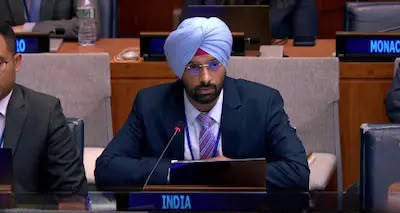
Delivering India’s right of reply, First Secretary Anmol Sher Singh Bedi challenged Pakistan’s position on cross border terrorism, the Indus Waters Treaty and nuclear proliferation. He stressed that diplomatic restraint must be accompanied by accountability for actions that threaten regional peace.
Bedi reiterated India’s position that its military response following the Pahalgam terror attack, which killed 26 civilians, was an act of self defence. He described India’s military action in May 2025 as measured and targeted, with the objective of countering the terrorist threat while avoiding a wider conflict.
He rejected the suggestion that the possibility of nuclear escalation should restrict India’s ability to respond to terrorist attacks. According to the diplomat, nuclear weapons must not become instruments that allow states to avoid the consequences of actions carried out through non state actors.
Indus Waters Treaty and Nuclear Proliferation
Bedi also addressed the dispute surrounding the Indus Waters Treaty, signed by India and Pakistan in 1960 with the World Bank’s involvement. He argued that agreements based on mutual trust and goodwill could not be separated from the responsibilities undertaken by the parties involved.
On nuclear proliferation, the Indian diplomat referred to the AQ Khan network, which was associated with the transfer of nuclear technology to foreign programmes. He also highlighted United Nations Security Council Resolution 1540, which requires countries to prevent non state actors from acquiring weapons of mass destruction and related materials.
Bedi urged governments and suppliers to exercise greater vigilance over nuclear cooperation and transfers of sensitive military technology, warning that proliferation posed wider international security risks.
India Rejects Nuclear Deterrence as a Shield for Terrorism
The diplomat maintained that countries could not escape responsibility for violence by operating through non state actors. He argued that relying on nuclear deterrence to discourage responses to terrorism could increase the risk of escalation rather than promote stability.
Bedi outlined India’s position that terrorist attacks would invite an appropriate response, that New Delhi would not bow to nuclear blackmail, and that those who sponsor terrorism must be held accountable alongside those who plan and execute attacks.
He also reiterated India’s position on Jammu and Kashmir, describing the region as an integral part of the country and calling for territories under what New Delhi considers illegal occupation to be vacated.
Concluding his remarks, Bedi said India remained committed to peace but maintained that lasting stability required responsibility, action against terrorism and efforts to prevent nuclear proliferation.
He argued that peace could not be sustained through calls for restraint alone when the underlying causes of regional crises remained unaddressed.