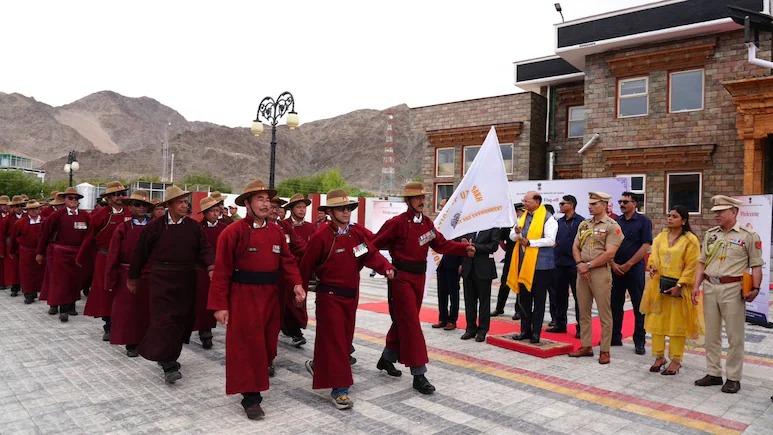
New Delhi: In a first for the Union Territory, the Ladakh administration has deployed 100 retired personnel from the Army, paramilitary forces and the Ladakh Scouts to form a dedicated Environment Protection Force (EPF) aimed at safeguarding the region’s fragile ecosystem.
The newly created force has been tasked with patrolling ecologically sensitive areas, preventing environmental violations and taking action against illegal off roading, littering, pollution and other activities that threaten Ladakh’s unique high altitude landscape. Members of the force have also been authorised to issue spot challans against violators.
The initiative comes shortly after authorities imposed fines totalling Rs 2 lakh on four tourists accused of driving through environmentally sensitive areas near Pangong Lake and allegedly chasing a Tibetan gazelle in a protected wildlife habitat.
The Environment Protection Force will be stationed across vulnerable ecosystems, wildlife habitats and other protected regions where unchecked tourism and off road driving have raised serious environmental concerns. Conservationists have long warned that illegal off roading damages fragile alpine vegetation, disturbs wildlife and leaves lasting scars on Ladakh’s cold desert terrain.
Announcing the initiative, Lieutenant Governor Vinai Kumar Saxena said the force would act as a strong deterrent against activities that endanger the region’s biodiversity. He said the personnel have been empowered to detect environmental violations, prevent illegal activities and issue penalties on the spot to strengthen enforcement across the Union Territory.
The retired servicemen will receive a monthly remuneration as part of the programme, which also aims to provide meaningful post retirement employment opportunities while making use of their experience and discipline.
The administration believes the initiative will play a key role in promoting responsible tourism, preserving Ladakh’s fragile environment and ensuring that increasing visitor numbers do not come at the cost of the region’s rich natural heritage.
Sorry, there was a YouTube error.