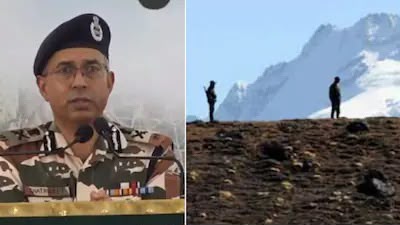
NEW DELHI: Face offs between Indian and Chinese troops have occurred at several locations along the border in Arunachal Pradesh in recent days and are continuing, Indo Tibetan Border Police (ITBP) Director General Shatrujeet Kapur said on Thursday.
Addressing personnel at an ITBP base in Alwar, Rajasthan, Kapur said the force had raised a new combat unit, the Shaurya commandos, which had demonstrated its capabilities during the ongoing face offs involving China’s People’s Liberation Army (PLA) at multiple locations in Arunachal Pradesh.
The commandos will be inducted into every border battalion, strengthening the force’s operational capabilities and preparedness along the India China frontier.
The ITBP chief’s remarks came in the context of routine deployment and operational readiness along the border, rather than referring to a specific incident.
Established in 1962, the ITBP is responsible for guarding the 3,488 kilometre Line of Actual Control (LAC) with China. Kapur also described the China frontier as India’s most challenging border, emphasising the need to strengthen capabilities to deal with a technologically advanced military.
He highlighted the growing importance of drones and counter drone systems, noting that modern warfare has changed significantly with the introduction of unmanned technology. He stressed that India must expand its use of these systems to respond effectively to evolving security challenges.
Kapur also announced a specialised training programme called ‘Strike’ for ITBP personnel. The course is designed to improve the force’s ability to respond to difficult combat situations, including scenarios similar to the 2020 Galwan Valley clash. The entire force is expected to undergo the training by the end of 2027.
The remarks come amid broader diplomatic efforts to maintain stability along the India China border. Chief of Defence Staff General NS Raja Subramani recently described the situation along the LAC as stable, highlighting continued dialogue and regular Border Personnel Meetings between the two sides.
External Affairs Minister S Jaishankar has also stressed that peace and tranquillity in border areas remain essential for normalising bilateral relations, warning that disturbances along the frontier would affect broader ties.
The latest developments underline the importance of maintaining military preparedness alongside diplomatic engagement as India continues to strengthen its border security infrastructure and operational capabilities.