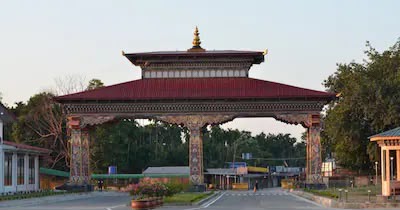
New Delhi: Bhutan has inaugurated a new immigration terminal at Gelephu Mindfulness City (GMC), introducing automated e gates that allow eligible Indian and Bhutanese nationals to complete immigration clearance through biometric verification at the land border.
The terminal was inaugurated by GMC Governor Dasho Dr Lotay Tshering and is part of the infrastructure being developed to support the city’s expansion and growing cross border movement between Bhutan and India.
The biometric system verifies travellers’ identities against their registered information, allowing eligible passengers to clear immigration without routine manual processing. The facility is expected to reduce waiting times and make border crossings more efficient, while retaining existing immigration checks. Travellers who have not registered their biometrics will continue to use staffed counters.
A nominal service fee is also expected to be introduced to support the maintenance of the terminal and the delivery of immigration services.
Initially, the facility will serve Indian and Bhutanese nationals who meet the applicable entry requirements. Arrangements for third country nationals will be introduced at a later stage in coordination with the relevant Indian authorities.
The development comes alongside India’s efforts to strengthen transport connectivity with Bhutan through two proposed railway links connecting Assam and West Bengal with Bhutanese towns.
The 69 kilometre Kokrajhar to Gelephu railway line and the 20 kilometre Banarhat to Samtse line are estimated to cost a combined ₹4,033 crore. The projects are expected to strengthen trade, tourism and people to people exchanges between the two countries.
The Kokrajhar to Gelephu line has been designated a Special Railway Project to accelerate approvals and land acquisition. India will finance railway works on its side of the border, while the Bhutanese section will receive support from the Indian government through the Ministry of External Affairs under Bhutan’s 13th Five Year Plan.
Gelephu Mindfulness City is a major development initiative envisioned by Bhutan’s King Jigme Khesar Namgyel Wangchuck. The special administrative region is progressing with plans for an international airport, spiritual landmarks and major investment projects.
The city is also preparing for Project 108, a royal initiative to construct 108 Jangchub Chortens along the Mau Chhu River. Each structure will stand 15 metres tall, with the monuments arranged in a single line 108 metres apart. The coordinated completion of their external structures is planned for November 1, 2026.
Together, the immigration terminal and railway projects reflect the growing emphasis on cross border mobility, regional economic cooperation and infrastructure development between India and Bhutan.